
How to Manage Airport Transfers for Executive Roadshows
Executive roadshows compress multiple cities into two or three days — each stop requires its own coordinated ground transport. Without central planning, the logistics unravel fast. Here's how to manage every transfer leg before the roadshow begins.
What Makes Roadshow Transfer Planning Different
Standard corporate travel has a predictable shape: one outbound flight, one return. Roadshows don't. A typical roadshow might cover Frankfurt, Amsterdam, and London in 48 hours — with back-to-back investor or client meetings at each stop. The executive isn't checking in for a three-night stay; they're arriving, presenting, and leaving within hours.
This compresses the tolerance for any transfer failure to near zero. A 20-minute delay at one airport doesn't just affect that leg — it cascades into every subsequent meeting. Understanding the what makes transfers reliable framework is especially critical here, because there's no slack in the schedule to absorb errors.
Pre-Booking All Legs Before the Roadshow Starts
Every transfer — arrival, inter-venue, departure — should be booked before the first flight departs. This is non-negotiable for roadshow logistics. Last-minute booking in an unfamiliar city, particularly during business hours when professional vehicles are in high demand, introduces unnecessary risk.
List every airport arrival, venue-to-venue move, hotel pickup, and departure. Include address, expected time, and flight or meeting reference for each.
Using one booking source across all cities keeps the record unified. It also makes it easier to modify a single leg without losing context on the others.
Vehicle availability and classification vary by city. What's a standard executive sedan in one market may not be available in another. Confirm the exact vehicle at each location.
20–30 minutes between the scheduled transfer arrival and the first meeting. The schedule already has no room for delays — the transfer plan should carry the buffer.
Consistent Vehicle Standards Across Every City
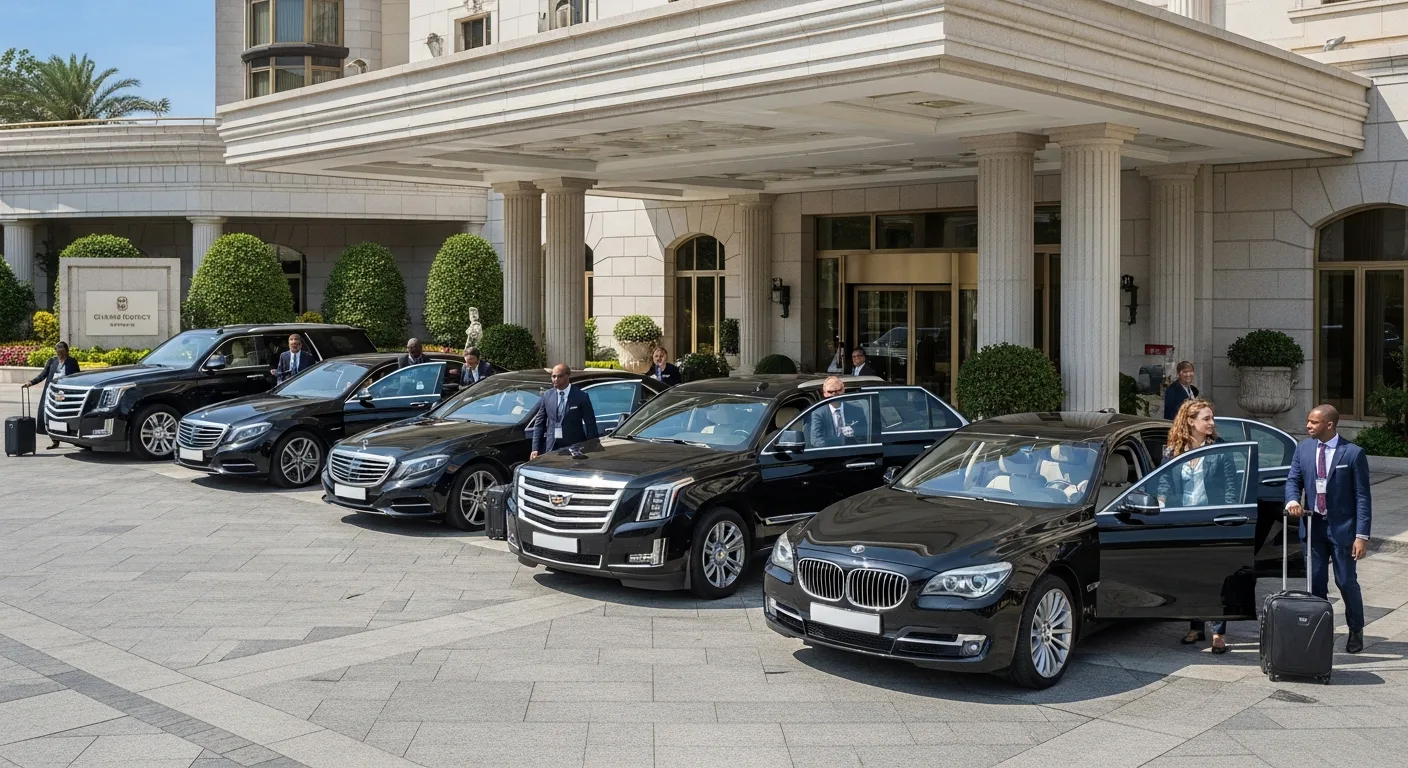
Executives traveling for investor meetings or client presentations are representing their organization at every point of contact — including the vehicle they arrive in. A premium sedan in one city and a standard hatchback in the next creates a jarring inconsistency that reflects poorly on the planning behind the trip.
When booking through a structured platform, you can specify vehicle category globally and expect the same class of vehicle at each stop. This is part of what the best vehicle for business travel selection process addresses — not just comfort, but consistency as a standard.
Local Coordination at Each Destination
The driver at each city should be briefed: executive name, meeting location, any preferences on communication, and what to do if the flight is delayed.
Someone needs to be tracking the inbound flight at each stop. If the schedule shifts, the transfer must shift with it — automatically if possible.
Each airport has its own terminal layout, pickup rules, and waiting zones. The driver should be familiar with the specific terminal — not just the airport code.
For inter-venue transfers, the driver should know the destination address in advance — not just the name — to avoid navigation delays in dense city centers.
What Goes Wrong Without Central Booking
The most common failure mode in roadshow transfers is fragmented booking. The EA books the first city, a local contact arranges the second, and the executive's assistant handles the third from their mobile app. The result is three different vehicle standards, three different communication channels, no unified record, and no one with full visibility of the schedule.
When a flight is delayed by 45 minutes, the fragmented approach means three separate people need to be notified and three separate arrangements need to be changed — in real time, from the airport, while the executive is trying to board the next flight.
Central booking through a single system eliminates this. All modifications flow through one point of contact, all confirmations land in one place, and the full itinerary is visible in one view.
Managing Delays Mid-Roadshow
Delays are not exceptional events on multi-city roadshows — they are routine. The question is not whether a delay will happen but whether the transfer plan can absorb it. Key practices include:
- Real-time flight tracking linked to transfer bookings
- Driver standby time built into the booking (not a strict pickup window)
- A single point of contact who can reroute transfers at any city if the schedule shifts
- Pre-confirmed backup vehicle availability in each city for worst-case scenarios
Documentation and Reporting After the Roadshow
After a multi-city roadshow, the travel record should be complete: every leg, every vehicle, every cost. This serves finance reconciliation, policy compliance review, and planning for the next roadshow. A centralized expense code tracking system makes post-trip reconciliation straightforward instead of a reconstruction exercise.
To explore Transferhood directly, you can visit the main platform.