
Amsterdam Schiphol Airport Transfer Guide
Schiphol is a single integrated terminal — simpler than most major hubs for navigation. But it serves not only Amsterdam, but also The Hague, Rotterdam, and other Dutch cities. Route and timing depend on where you're going, not just that you're departing from Schiphol.
Schiphol's Terminal Layout
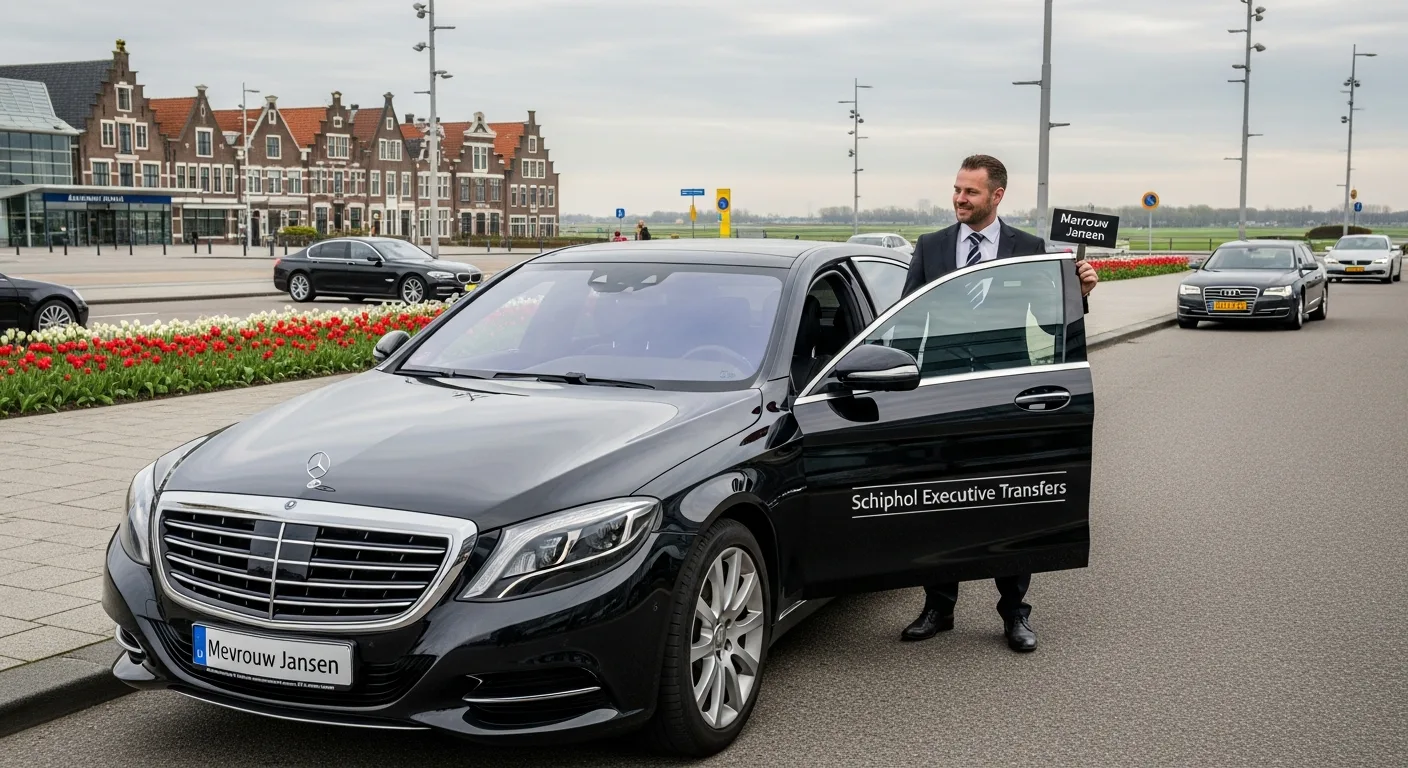
Amsterdam Airport Schiphol (AMS) operates as a single terminal building with three departure halls (piers) connected airside. From a ground-transportation perspective, this is straightforward: all arrivals exit through a single Arrivals Hall on the ground floor (level 0 of Schiphol Plaza). This is where private transfer drivers wait, typically in the designated meeting area inside the Arrivals Hall near the exits from customs.
Unlike multi-terminal airports, there is no ambiguity about which building to go to. The challenge at Schiphol is the volume — on peak days, the Arrivals Hall can be crowded and finding your driver requires a clear communication protocol. A professional meet and greet service at Schiphol will specify the exact meeting point within the Arrivals Hall so there is no searching involved.
Schiphol's Arrivals Hall can be busy and slightly disorienting on first visit. Confirm the precise meeting spot — a specific pillar number, exit gate letter, or meeting-board location — with your transfer provider in advance. The general "Arrivals Hall" is not specific enough during peak hours.
Schiphol as a Regional Hub
Schiphol is not only an Amsterdam airport — it serves as the primary international gateway for the entire Dutch Randstad region. Significant transfer volumes go to The Hague (seat of government), Rotterdam (port city and business center), Utrecht, Leiden, Delft, and other cities in the region. This makes Schiphol a genuinely multi-destination airport, and the route planning for each city is distinct.
The airport is southwest of Amsterdam city center, approximately 15–20 km by road. Routes use the A10 ring road or the S106 approach. Plan for 20–40 minutes off-peak. The A10 ring and its approach junctions are the main congestion points during morning and evening rush hours.
Zuidas is the business district directly north of the airport, connected by the A10 southern section. Plan for 10–20 minutes. This is one of the shortest airport-to-destination routes in any major European city.
Approximately 40 km southwest via the A4 motorway. Plan for 30–50 minutes depending on A4 traffic. The A4 is generally reliable but can see delays near the Prins Clausplein interchange.
Approximately 60 km via the A4 and A13. Plan for 45–65 minutes. The A13 Rotterdam approach can be congested during weekday peaks.
Approximately 45 km via the A2. Plan for 35–55 minutes. The A2 Utrecht interchange is one of the busiest junction points in the Netherlands and is frequently subject to delays.
Leiden is approximately 25 km west via the A44 — plan for 25–35 minutes. Delft is roughly 45 km via the A4 — plan for 35–50 minutes. Both routes are generally straightforward outside peak hours.
The A10 Ring Road: Amsterdam's Congestion Variable
Amsterdam's A10 ring road is the primary orbital motorway around the city. For transfers from Schiphol to Amsterdam Centrum, Noord, or the eastern districts, the A10 is either the direct route or a key junction point. The ring has several chronic congestion spots, particularly around the Amstel (S112) and Watergraafsmeer (S113) junctions during weekday peak hours.
Morning inbound peaks (07:30–09:30) and evening outbound peaks (16:30–19:00) are the most significant. A Schiphol-to-Amsterdam Centrum transfer that takes 25 minutes at 10:00 may take 45–55 minutes at 08:30. When selecting your pickup time, account for which direction you're traveling and when.
What to Specify When Booking
Schiphol serves multiple Dutch cities. Specifying "Amsterdam" versus "The Hague" versus "Rotterdam" determines the entire route. Always provide a full street address or hotel name with city.
Schiphol handles large volumes of wide-body long-haul arrivals. Baggage collection time can vary. Providing your flight number allows driver positioning to account for actual landing time and estimated exit window. This is part of how airport pickup operations function at a hub like Schiphol.
For multi-city trips within the Netherlands where the vehicle travels to Rotterdam or The Hague, the journey time is longer and comfort matters. Confirming passenger count and luggage upfront ensures the right vehicle is used. Check guidance on vehicle category selection for longer inter-city runs.
In a large Arrivals Hall, "inside arrivals" is not precise enough. Confirm whether your transfer service uses a specific pillar, an electronic meeting board area, or the dedicated transfer lounge. Establish the exact rendezvous point before your flight lands.
To explore Transferhood directly, you can visit the main platform.