
How Business Travelers Can Choose the Most Suitable Transfer Vehicle
Business travel has a specific set of transfer requirements: predictable timing, sufficient space for working equipment, and a vehicle that reflects the professional context of the journey. The right category is rarely the most expensive — it is the one that matches the actual trip profile.
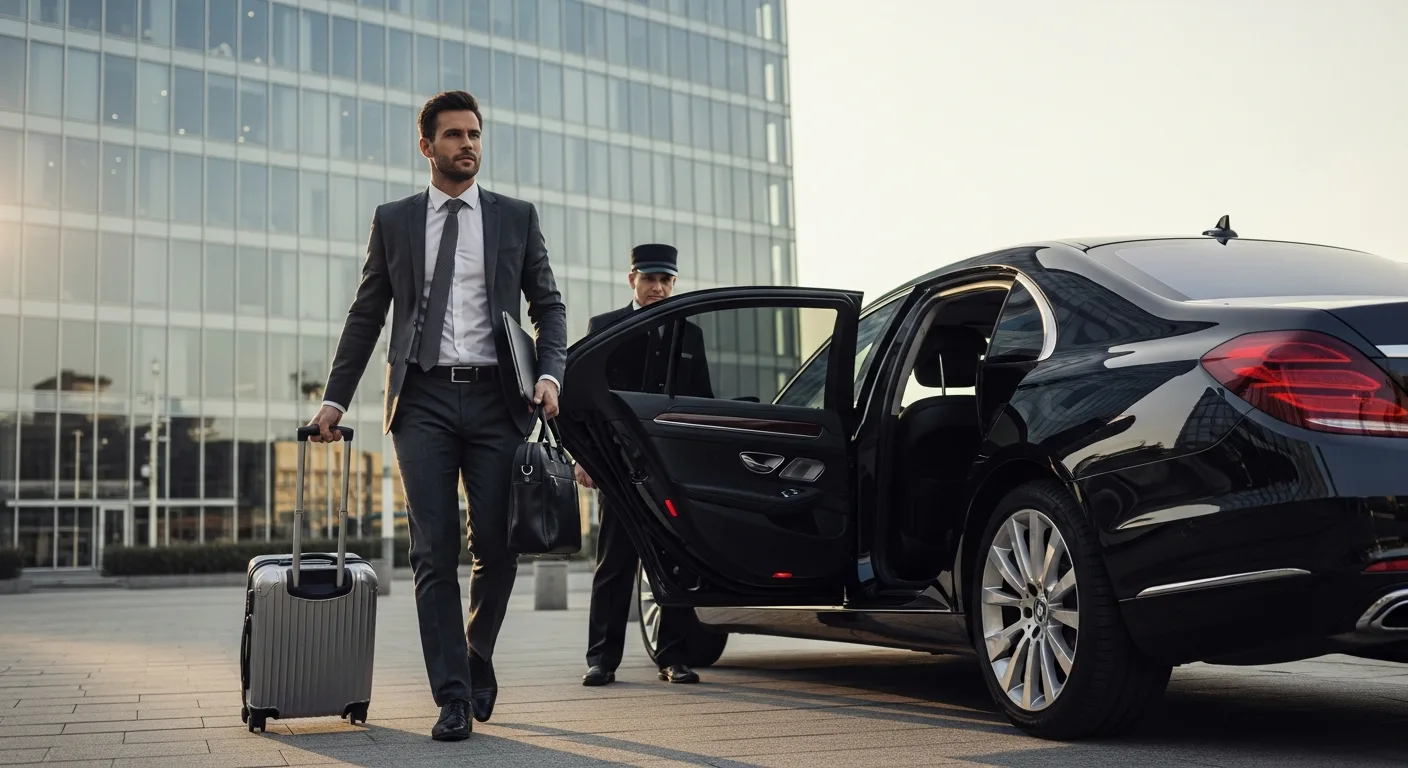
The Business Travel Profile
Most business travel involves a solo traveller or a pair, a laptop bag plus a cabin bag or small trolley case, and a destination that is a hotel, office, or conference venue. The route is often direct, the timing is tight, and the driver needs to be at the right terminal at the right time without any ambiguity.
This profile maps cleanly onto the vehicle category selection framework: the Comfort category covers most solo and duo business travel cases, and the decision to upgrade depends on specific trip factors rather than habit.
Economy vs Comfort for Business Travel
Adequate for solo travel with minimal luggage on a short route. If the journey is under 30 minutes, the luggage is a single cabin bag, and the trip is not client-facing, Economy covers the requirement without over-specifying.
The standard business travel choice. Additional legroom, marginally more cabin space, and a slightly larger boot for the combination of a laptop bag, trolley case, and carry-on that most business trips involve. Better suited to routes over 30-40 minutes.
The practical difference between Economy and Comfort for a solo business traveller with a laptop bag and carry-on is primarily in cabin space and seat comfort — not luggage capacity. On a 20-minute urban transfer, Economy is sufficient. On a 90-minute intercity route with a full workday to follow, Comfort makes more sense.
When to Consider an SUV for Business Travel
An SUV becomes relevant for business travel in specific cases, not as a default upgrade:
- Travelling with a client or senior colleague where shared comfort is a factor
- Carrying substantial luggage alongside standard business equipment — a checked bag plus presentation materials or samples
- Routes where the extended space is genuinely useful — long intercity transfers where working in transit is expected
- Airport pickups where the passenger needs to change or prepare on the way to the destination
Client-Facing Trips: What Changes
When a transfer involves picking up or accompanying a client, the vehicle category carries more weight than in internal travel. The decision to use a Comfort or SUV vehicle for client collection is partly about presenting an appropriate professional standard. The key question is whether the vehicle reflects the context of the relationship — a client transfer to a significant meeting has different expectations than an employee commute from the office to the airport.
This is also an area where corporate transfer booking adds value — standardised policies determine the vehicle category for client trips, removing ad-hoc decision-making from the equation.
Business Luggage Realities
Laptop bag and possibly a small backpack. Economy or Comfort is fully sufficient. Luggage is entirely in the cabin; boot space is not a factor.
One cabin-size trolley case and a laptop bag. Comfort handles this well. Boot space needed for the trolley case; laptop bag in the cabin.
One large checked bag plus carry-on and laptop bag. Still within the Comfort boot range for a solo traveller. SUV only necessary if additional items are included.
Checked bag plus presentation materials, samples, or event materials. Boot volume may push toward an SUV — confirm total luggage count before booking rather than assuming Comfort is sufficient.
Standardising Vehicle Selection in Corporate Bookings
Frequent business travellers benefit from consistent vehicle category policies — one fewer decision to make during an already time-pressured travel day. Setting Comfort as the standard category for solo business travel and SUV for client-facing trips removes ambiguity and prevents both under-specification (wrong vehicle, inadequate space) and over-specification (unnecessary upgrades on routine trips). Exploring the full range of economy, comfort, SUV and minivan options clarifies where each category's appropriate use case sits.
To explore Transferhood directly, you can visit the main platform.