
How Multi-Stop Transfer Planning Works in Practice
A multi-stop transfer connects more than two locations in a single continuous journey — airport to hotel to conference venue, for example, or hotel to office to airport. Each intermediate stop adds route complexity, time estimation requirements, and vehicle considerations that a standard A-to-B booking does not encounter.
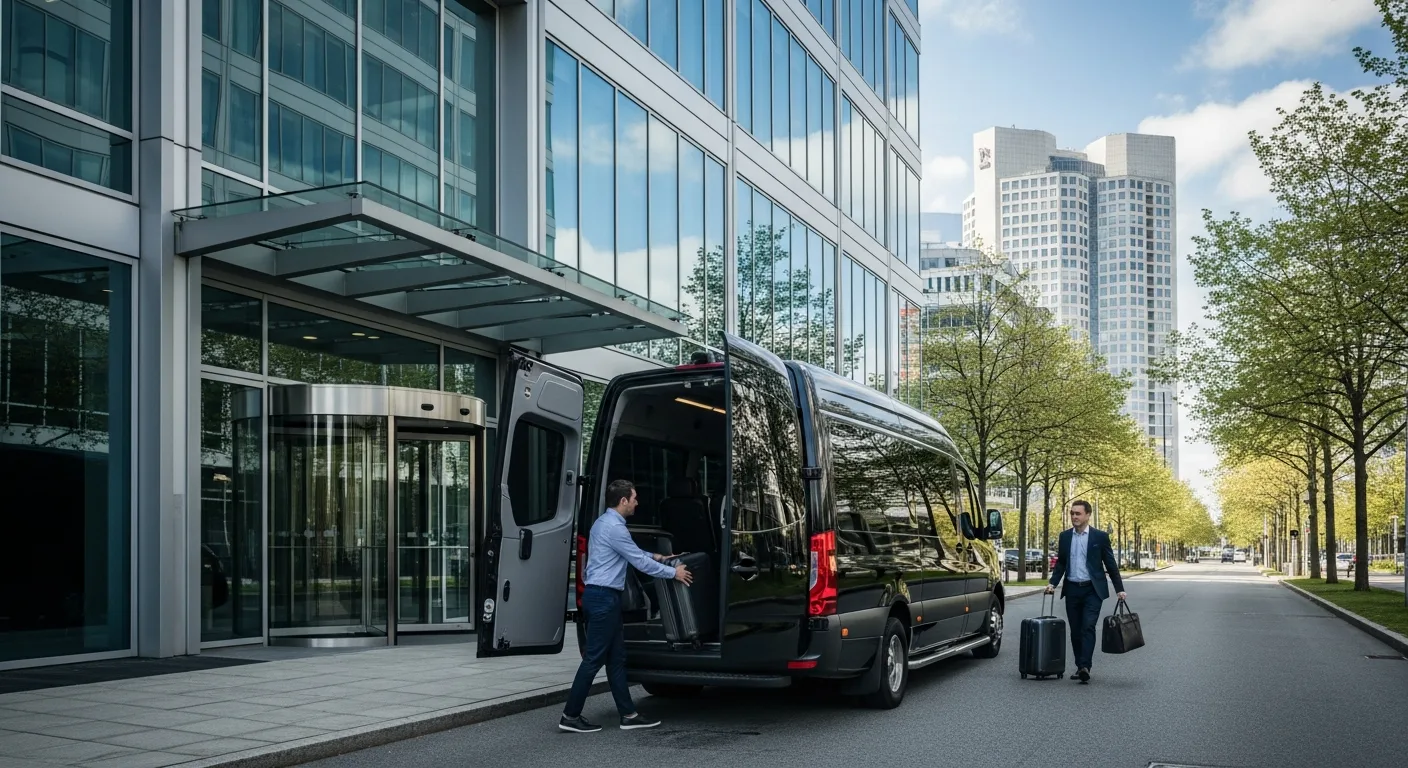
What Defines a Multi-Stop Route
A multi-stop transfer is any journey where the vehicle makes one or more intermediate stops between the origin and final destination — stops where the vehicle pauses, a passenger boards or alights, luggage is handled, or a wait is required. This is distinct from a single direct A-to-B journey.
Common multi-stop scenarios include:
- Airport arrival followed by hotel dropoff, then transfer to a separate meeting venue the same day
- Hotel pickup with a stop at a colleague's property before proceeding to the airport
- Airport pickup with a stop at a pharmacy or retail point, then hotel dropoff
- Corporate transfers that collect passengers from multiple locations before going to one destination
Each of these requires a different approach to route construction, time estimation, and booking detail compared to a single-leg transfer. Understanding how standard transfer booking works helps clarify what additional information multi-stop planning introduces on top of that baseline.
Route Sequencing and Its Impact on Time
The order of stops is not arbitrary — it directly determines route efficiency and total journey time. A stop that is on the natural path between origin and destination adds relatively little time. A stop that requires a significant detour from the optimal route adds time proportional to that detour, plus the pause at the stop itself.
When booking a multi-stop transfer, the order in which stops are listed matters. The system uses that sequence to calculate the route and estimate durations. If the traveler lists stops in a different order than the geographic logic suggests, the route may be suboptimal — and the time estimate will reflect that. For complex urban routes with multiple close-together stops, it is worth considering whether the sequence provided is actually the most efficient path through those locations.
Time Estimation at Each Intermediate Stop
An intermediate stop requires a dwell time estimate — how long the vehicle will be waiting at that point. This is not a value the system can determine independently; it depends on what the traveler needs to do at each stop. Options include:
- A brief pass-through stop where a passenger boards or a bag is dropped — typically a few minutes
- A functional stop where the traveler needs to complete an activity before returning to the vehicle — a hotel check-in, a quick office pickup, or a collection from a building reception
- An extended wait where the driver holds position for a variable or uncertain duration
The dwell time at each stop compounds into the total journey duration and therefore into how the final destination arrival time is calculated. If the booking is connected to a flight departure at the end of the route, underestimating stop durations can produce a final airport arrival that is too close to the boarding window.
Multi-stop bookings with a flight at the end carry a compounding time risk that single-leg transfers do not. Each stop that runs longer than estimated reduces the buffer at the airport. The total margin should be calculated against the worst case for each stop, not the best case.
Vehicle Requirements Across a Multi-Stop Route
The vehicle selected for a multi-stop journey must be appropriate for the maximum load it will carry at any point during the route — not just the starting load. If a journey begins with two passengers but picks up two more at an intermediate stop, the vehicle category must accommodate four passengers from that stop onwards, not just the original two.
Similarly, luggage may increase at an intermediate stop. A traveler who starts with carry-on luggage but collects checked luggage from a hotel during the route needs a vehicle with storage capacity for both. The guidance on how pickup and dropoff details affect operations applies to each individual stop in a multi-stop route, not just the origin and final destination.
Vehicle category is determined by the highest passenger count at any point in the route. A vehicle that fits the starting count but not the post-pickup count creates a capacity failure mid-journey.
Luggage may accumulate across stops. State the total luggage expected by the end of the route, not just what is present at the first pickup point.
Location Specificity at Each Stop
Each intermediate stop requires the same level of address detail as the primary pickup and dropoff. A multi-stop booking with a precise origin and destination but a vague intermediate address creates a coordination gap at exactly the point where the driver needs to pause, confirm, and proceed efficiently.
For stops at corporate venues, conference centers, or large hotel complexes, the specific entrance, wing, or access point matters as much for an intermediate stop as it does for the primary location. If the driver needs to call the passenger to find the intermediate stop, that call eats into the estimated dwell time and adds pressure to the remainder of the route.
How Multi-Stop Bookings Are Processed Operationally
A multi-stop booking is treated as a single reserved service that spans the full route from origin to final destination. The driver is briefed on all stops, their sequence, the expected dwell time at each, and any specific instructions at intermediate locations. The vehicle is allocated for the full duration, not just the first leg.
This means the driver cannot take another job between the stops — the vehicle is committed to the full itinerary from first pickup to final dropoff. Operationally, this is priced and scheduled as a continuous service rather than a series of separate transfers. For groups or corporate travelers coordinating multiple passengers across several points, the post on group transfer vehicle planning addresses how vehicle selection scales when passenger counts are higher across a complex route.
What to Provide When Booking a Multi-Stop Transfer
List every location the vehicle needs to visit, in the order it should visit them. Each address should be complete and specific enough for independent navigation.
State how long the vehicle will be waiting at each stop. Use a realistic estimate based on what will happen there, not a best-case assumption.
Declare the highest number of passengers and total luggage volume at any single point in the journey, not just at the starting point.
Access codes, reception contacts, restricted vehicle zones, or particular entrances that apply to intermediate stops should be noted in the booking, not assumed to be resolved on arrival.
To explore Transferhood directly, you can visit the main platform.