
How Passenger Count Affects Vehicle Selection in Airport Transfers
Passenger count sets a minimum requirement for seat availability, but it rarely determines the final vehicle choice on its own. In most airport transfer situations, the luggage volume carried is the binding constraint — not the number of seats needed.
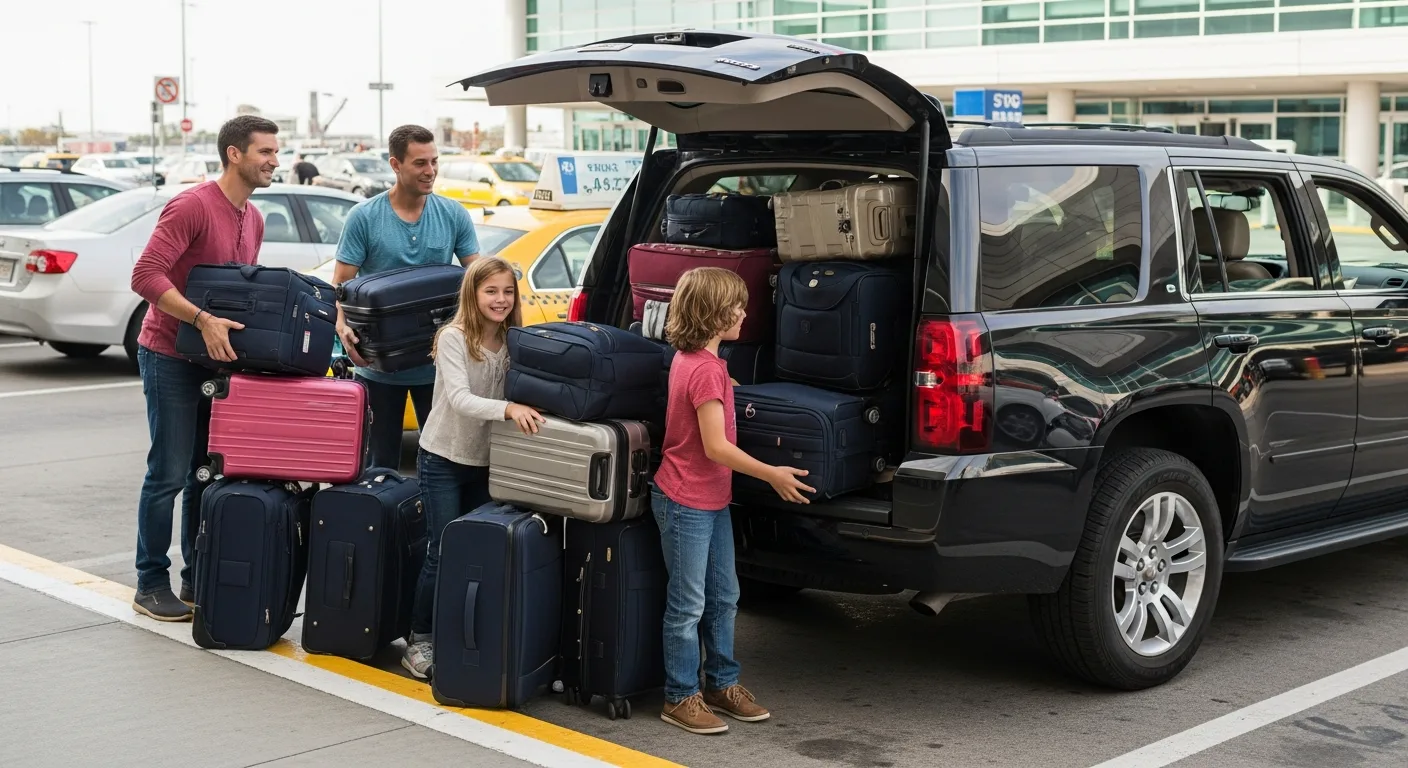
Seats and Trunk Are Independent Limits
Every vehicle category has two capacity ceilings: the number of passengers it can seat, and the luggage volume its boot can accommodate. These two limits operate independently. A vehicle can have three available seats and a trunk that cannot fit three full-size checked bags simultaneously. When the luggage ceiling is hit before the seat ceiling, the vehicle becomes over-capacity even if seats remain empty.
This is the most frequently misunderstood aspect of luggage details in transfer bookings. Passengers select a vehicle based on seat count, then arrive at pickup with more luggage than the boot can hold.
Standard Capacity Guidelines by Category
Up to 3 passengers. Boot capacity: typically 2-3 standard 23kg suitcases. A solo traveller with a large bag and oversized item may already be near the limit.
Up to 3 passengers. Marginally more boot volume than Economy in most models. A pair with two large checked bags and two carry-ons fits comfortably.
Up to 4 passengers. Boot volume is significantly higher — typically 4-5 standard bags. The practical choice when luggage volume is the primary constraint.
Up to 6-8 passengers. Highest combined passenger and luggage capacity. Designed for group travel with full luggage sets, child equipment, or oversized items.
When Luggage Overrides Seat Count
The following scenarios illustrate when luggage volume forces an upgrade regardless of how many seats are needed:
A couple returning from a two-week trip with two large suitcases each plus carry-ons. Two seats available in Economy — but the boot will not accommodate four large bags. SUV is the correct selection.
Three passengers fit in a sedan. The stroller does not. The boot is full before carry-ons are loaded. Minivan or SUV is required.
Solo traveller returning from a ski trip. A single passenger creates no seat pressure, but the ski bag occupies the entire boot of an Economy or Comfort vehicle. An SUV is the practical choice.
Four people travelling with laptop bags and small carry-ons. An SUV or Minivan seats everyone. In this case passenger count, not luggage, is the binding limit — and the right category is determined by seat availability alone.
The Rule for Borderline Cases
When in doubt between two adjacent categories, calculate the total luggage volume first — not the passenger count. If the luggage total is at or near the capacity limit of the lower category, select the higher one. An over-specified vehicle costs slightly more; an under-specified vehicle creates a problem at pickup that cannot be resolved quickly.
Child Equipment and Passenger Count
Children travelling with strollers, pushchairs, or car seats add a dimension that is separate from both seat count and standard luggage volume. A family of three — two adults and one child — may only need three seats, but the stroller, child seat, and standard luggage together typically require an SUV or Minivan regardless of the seated passenger count. This is covered in more detail in the guide on vehicle category selection for different trip types.
When to Upgrade the Vehicle Category
- Total luggage volume approaches the standard limit for the base category
- Any oversized item (stroller, ski bag, bike bag, large sports equipment) is part of the trip
- The passenger count reaches the rated maximum and luggage is not minimal
- The trip involves a combination of seated children with child seats and full adult luggage
A useful cross-reference is the guide to when to book each specific vehicle category, which maps these combinations to the correct selection for the most common trip configurations.
To explore Transferhood directly, you can visit the main platform.