
How to Plan a Transfer for Families with Extra Bags or Child Equipment
Family airport transfers generate more complexity per passenger than any other trip type. Child equipment, multiple large bags, and different passenger mobility needs combine to create a luggage and vehicle planning challenge that does not resolve itself at the kerb. The decisions need to be made at booking time.
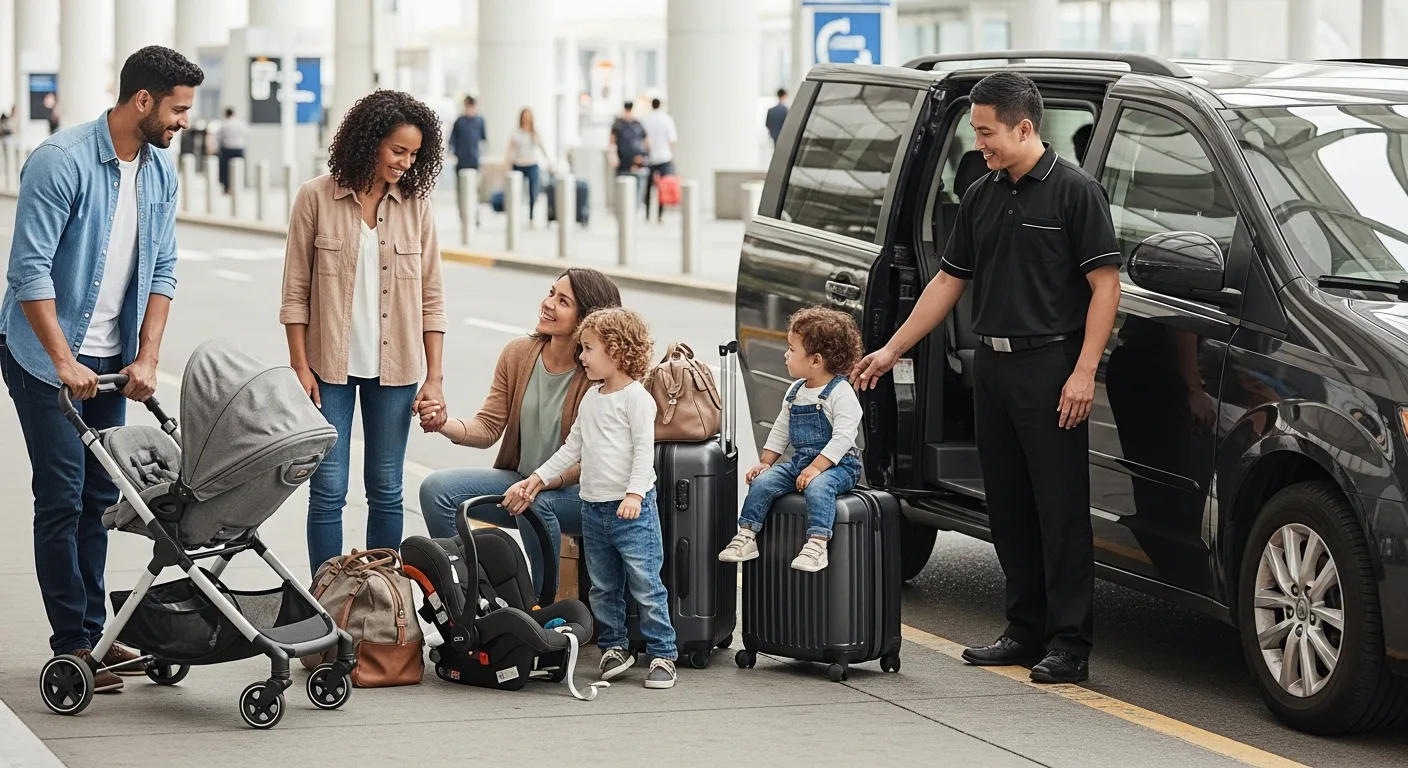
Why Family Transfers Are a Different Planning Problem
A family of four — two adults, two children — occupies four seats. On paper, that is within the capacity of an SUV or a large sedan. In practice, the same family often travels with two large checked suitcases per adult, a stroller, a child seat, plus cabin bags and a nappy bag. The actual boot volume required is that of a Minivan, not a sedan-class vehicle.
The key principle when booking luggage details for family trips is to account for child equipment as separate line items alongside standard luggage — not to assume it will fit in whatever space remains.
Child Equipment: What Counts and How Much Space It Takes
When folded, a compact stroller occupies roughly 40-60 litres — equivalent to a medium suitcase. Larger travel strollers or tandem models for two children occupy significantly more.
A standard infant or toddler car seat occupies approximately 40-50 litres in the boot when not in use. It cannot be compressed or folded. If the child is using it in-vehicle during the journey, it takes a seat position and additional installation time at handover.
Full travel system pushchairs that combine pram and car seat are among the most space-demanding items. When folded, many occupy the equivalent of two large suitcases in boot space.
A travel cot in its carry bag typically takes 60-80 litres of boot space. This is rarely declared at booking but significantly reduces available trunk capacity for standard luggage.
Typical Family Configurations and the Right Vehicle
Three effective passengers plus a stroller and infant car seat. Even with moderate adult luggage, the boot requirement typically exceeds a standard sedan. An SUV is usually the minimum.
Four passengers. Add two large adult suitcases, two smaller children's bags, a foldable stroller, and carry-ons. This profile consistently requires a Minivan. An SUV may work if the stroller is compact and luggage is minimal.
Five passengers with substantial combined luggage and likely a stroller or two. A Minivan is the only category that comfortably handles this configuration.
Five passengers with five adult luggage sets plus child equipment. The Minivan is required. In some cases, two vehicles may be a cleaner option depending on the luggage total.
What to Specify When Booking a Family Transfer
- Total number of passengers including children (specify ages for infant/toddler classifications)
- Number of large checked bags per adult
- Number and type of child equipment: stroller, car seat, travel cot
- Whether a child seat will be needed in the vehicle during travel, or only transported in the boot
- Any additional oversized items: beach equipment, sports bags, large toys
If a child seat is needed installed in the vehicle during transit, this must be flagged at booking — not at pickup. Some operators provide child seats on request; others require the passenger to bring their own. The distinction affects the effective seat count and must be confirmed before the journey.
Minivan or SUV: Which Fits a Typical Family?
The deciding factor between an SUV and a Minivan for family travel is whether everyone plus all equipment fits in one vehicle. An SUV handles a family of three with moderate luggage. A Minivan is the right answer for four or more passengers travelling with full luggage sets and child equipment. The guide on when to choose a Minivan covers the specific thresholds in more detail.
Reviewing the general vehicle category selection framework can also help clarify where a specific family configuration sits across the full category range before making a booking decision.
Additional Planning Considerations for Families
- Allow more time at the pickup point — loading a stroller and child seats takes longer than standard luggage
- Confirm whether the operator requires advance notice for child seats rather than assuming availability on the day
- For return journeys, confirm that the same vehicle type is booked for both directions — luggage rarely decreases on the way back
- If travelling with a large stroller that is gate-checked, be aware it will arrive at the oversized baggage belt, not the standard carousel — this affects pickup timing
To explore Transferhood directly, you can visit the main platform.