
International vs Domestic Terminal Transfers: What Changes Operationally
Whether you arrive on an international or domestic flight changes your exit time, your arrivals exit location, customs processing, and driver wait expectations. These are not minor differences — they affect the entire timing structure of the pickup.
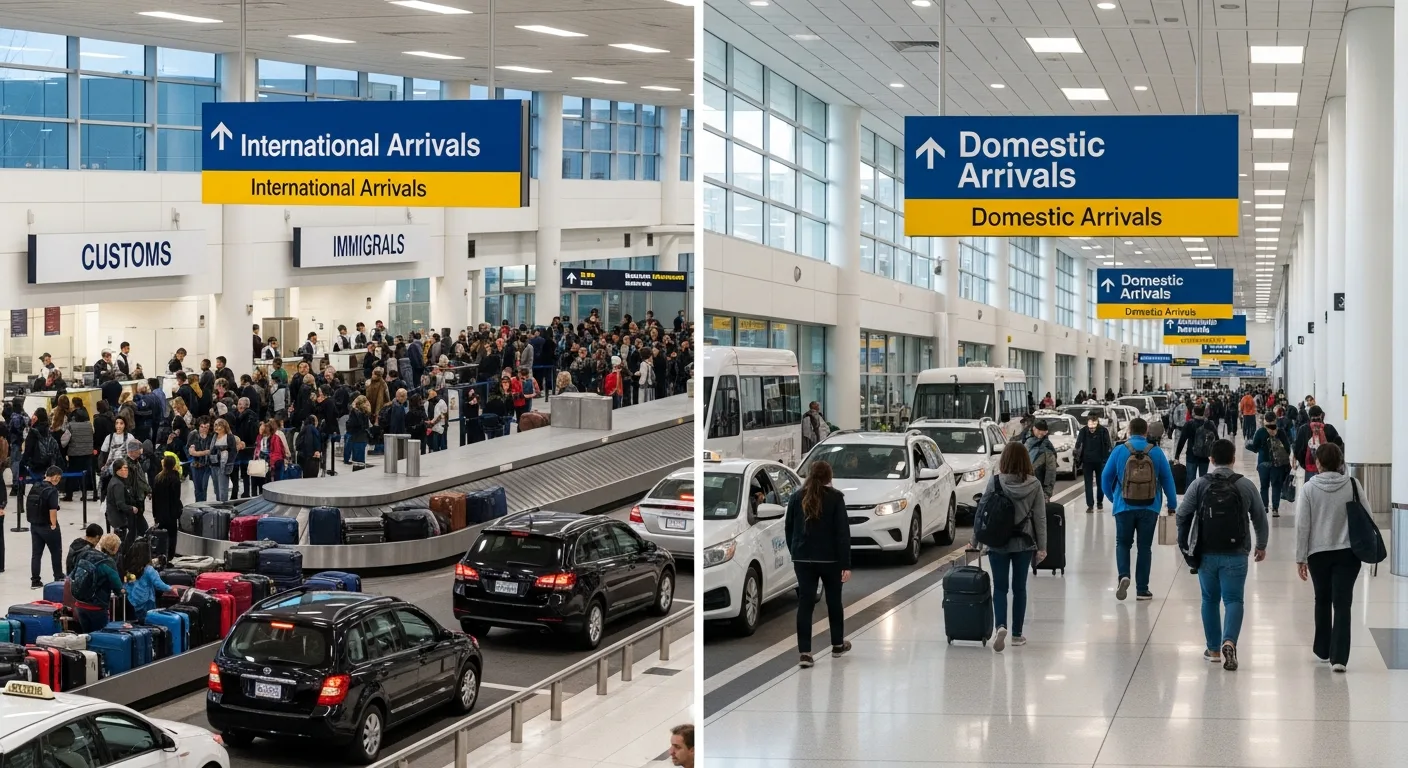
The Core Difference: Customs and Immigration
International arrivals must pass through border control and customs before reaching the public arrivals hall. This adds 20 to 60 minutes to the total exit time from landing, depending on airport, origin country, time of day, and queue volume.
Domestic arrivals have no such step. Passengers exit the aircraft, collect baggage, and walk to the arrivals exit — typically 10 to 25 minutes from landing. This makes domestic pickups far more time-predictable than international ones.
International Arrivals
- Passport control / immigration queue
- Customs declaration and screening
- Larger aircraft, longer baggage queues
- Exit time: 30–60 min post-landing
- Separate physical exit from domestic
- Driver needs extended wait tolerance
Domestic Arrivals
- No passport control required
- No customs processing
- Smaller aircraft, faster baggage
- Exit time: 10–25 min post-landing
- Separate exit from international
- Faster, more predictable pickup window
Exit Point Differences
At most airports, international and domestic arrivals do not share the same exit — they emerge from different sections of the terminal, often on different floors or sides of the building. A driver at the international exit will not see domestic passengers, and vice versa.
At Frankfurt FRA, non-Schengen arrivals exit from Hall B while Schengen arrivals use Hall A. At Istanbul IST, domestic exits are in a separate concourse section. Providing your departure country as part of flight and terminal details allows the correct exit point to be mapped at booking.
How This Affects Pickup Timing
Exit times vary from 25 minutes on a quiet day to 60+ with long queues. Drivers must be prepared to wait. Transfer services using flight delay monitoring adjust staging time dynamically based on live landing data.
Domestic exit times are consistent. If a domestic flight lands at 14:20, the passenger is typically at the exit by 14:38 to 14:45. Drivers can calculate staging with greater precision.
Intercontinental flights carry 200+ passengers queuing for immigration simultaneously. Processing alone can take 40 minutes. Plan long-haul arrivals with 50 to 70 minutes buffer from landing to exit.
Schengen vs Non-Schengen in Europe
Within European airports, there's an additional layer. Schengen zone arrivals (intra-EU plus Norway, Switzerland, Iceland) use fast e-gates — processing under 3 minutes. Non-Schengen arrivals (USA, UK post-Brexit, Asia, Middle East) queue for full border control.
A flight from New York to Frankfurt needs a 50-minute customs buffer. A flight from Berlin to Frankfurt needs 15 minutes. Both land at Frankfurt FRA — but they are not the same pickup scenario. Specifying departure country at the booking process stage ensures the correct buffer is applied.
Baggage and Waiting Time
International long-haul arrivals have larger checked bag loads and carousels shared by 200+ passengers — baggage can take 20 to 35 minutes post-landing. Domestic flights typically have faster delivery. Delayed baggage is a separate event from flight delay, but it directly extends how long the driver waits. Understanding waiting time in airport transfers — including how long is reasonable and what's included — applies here.
Departure Differences: International vs Domestic
Departure transfers also differ. International departures require earlier airport arrival — check-in closes earlier, security and border checks take longer, gate distances at international terminals are greater. This affects pickup time selection for departure transfers. Domestic departures can generally be executed with shorter lead times.
What to Communicate at Booking
- Whether your flight is international or domestic
- For international: departure country/region (Schengen vs non-Schengen)
- Flight number — determines exit type and timing profile automatically
- Any factors slowing exit: large group, checked sports equipment, infant items
To explore Transferhood directly, you can visit the main platform.