
Rome Airport Transfer: Fiumicino and Ciampino Guide
Rome is served by two airports on opposite sides of the city. Fiumicino is the main international hub to the west; Ciampino is a smaller secondary airport to the southeast. Route, timing, and terminal details differ significantly between the two.
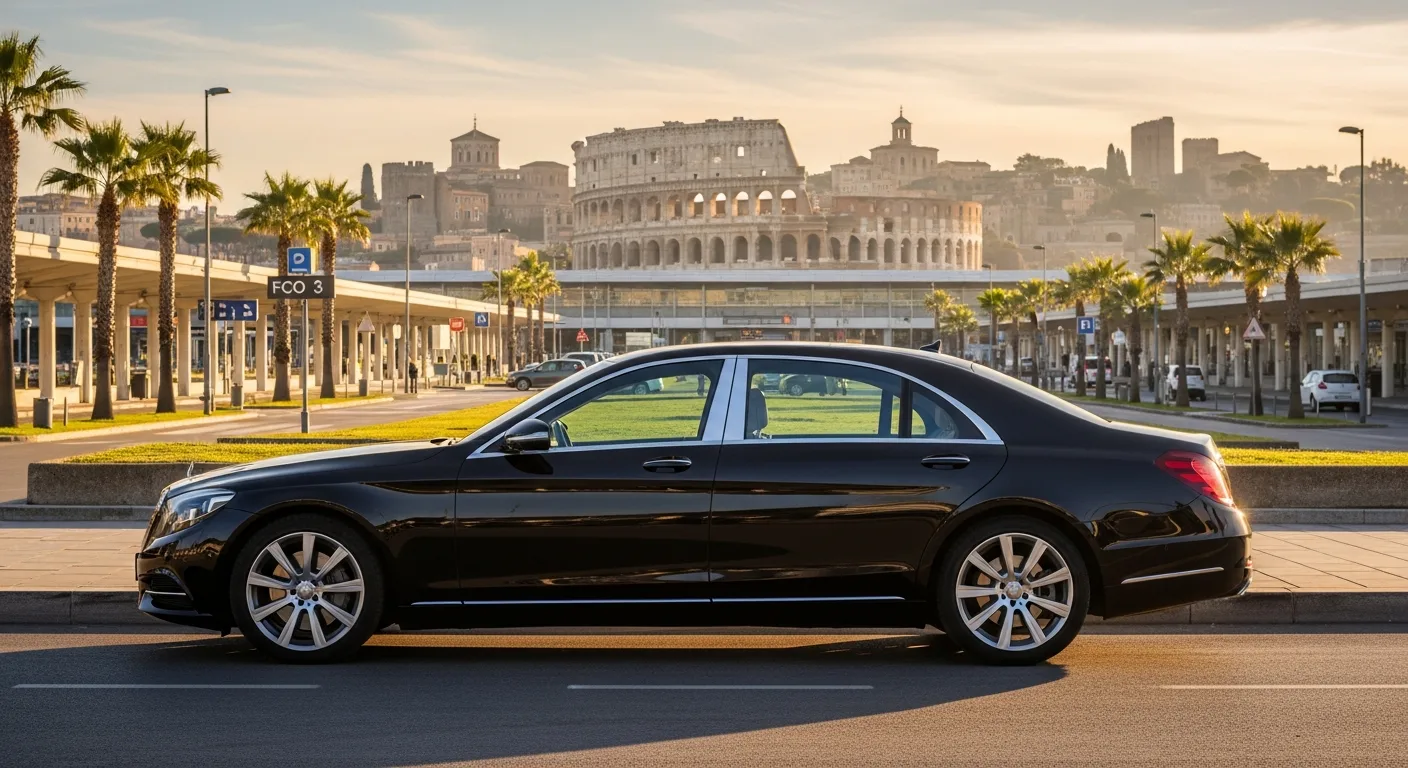
Fiumicino (FCO) and Ciampino (CIA): Two Different Operations
Rome's primary international hub, officially named Leonardo da Vinci International Airport. Located approximately 30 km southwest of Rome city center. Handles full-service carriers, long-haul intercontinental flights, and most scheduled European traffic. Has multiple terminals. The route to Rome uses the A91 motorway and the GRA ring road.
A smaller secondary airport approximately 15 km southeast of Rome. Primarily serves low-cost carriers including Ryanair and Wizz Air. Smaller facilities, shorter processing times, and fewer amenities than Fiumicino. Route to Rome uses the SS215 Via Tuscolana or the A1 motorway approach. The shorter distance does not always mean a shorter transfer time.
Fiumicino Terminal Structure
Fiumicino has undergone multiple expansions, resulting in a terminal layout that is spread across a large campus. The main terminals for scheduled passenger traffic are:
- Terminal 1 (T1): Domestic Italian routes and some European traffic. Compact and straightforward for transfer vehicle collection.
- Terminal 2 (T2): Adjacent to T1, used by some European carriers. Connected to T1 internally.
- Terminal 3 (T3): The main international arrivals terminal for non-Schengen and intercontinental flights. This is where most long-haul passengers arrive. Has a clear arrivals hall with designated private transfer pickup areas outside the customs exit.
- Terminal 5 (T5): A separate building used for flights to the United States and Israel, which require enhanced security screening. Located at a different point on the airport road. If you are arriving from a US-originating flight, confirm whether your flight uses T5 — the transfer vehicle collection point is not the same as T3.
T5 at Fiumicino is physically separated from the main terminal complex. A driver at T3 cannot cover a T5 arrival. If your flight arrives from the US or Israel, verify your terminal before confirming your booking details.
Routes and Timing from Fiumicino
The primary route from FCO to Rome city center uses the A91 motorway eastbound, joining the GRA (Grande Raccordo Anulare, Rome's ring road) and then taking radial roads into the city. The GRA is a critical variable — it connects all approaches to Rome and can be heavily congested at peak hours, particularly on the western and southern sections near the airport corridor.
- FCO to Rome historic center (Colosseum, Pantheon, Piazza Navona): Plan for 40–60 minutes off-peak. GRA and inner-city traffic can push this to 75–90 minutes during morning or evening peaks.
- FCO to Vatican area (Prati, Borgo Pio, Trastevere): These neighborhoods are on the western side of the city, closer to the airport approach. Plan for 35–55 minutes — one of the more accessible zones from FCO.
- FCO to Termini / Esquilino (central hotel district): Plan for 45–65 minutes. The approach through the GRA eastern section and Via del Corso corridor adds inner-city time.
- FCO to EUR district (business and conference center): Plan for 25–40 minutes. EUR is south of center and relatively close to the airport via the A91/GRA western arc.
- FCO to Parioli / north Rome: Plan for 55–75 minutes. Requires crossing the GRA northern section and entering the city from the north.
Routes and Timing from Ciampino
Despite Ciampino's closer proximity to Rome's southern boundary, the routes into the city center involve either the Via Tuscolana (a congested urban arterial road) or the A1 motorway via the GRA eastern section. Neither route avoids inner-city traffic for the final approach.
- CIA to Rome historic center: Plan for 30–50 minutes. The GRA eastern section and Via Appia Nuova approach are the typical routing.
- CIA to Termini area: Plan for 25–45 minutes via Via Casilina or the GRA.
- CIA to EUR district: Plan for 30–45 minutes, slightly longer than from FCO despite geographical proximity — the routing adds distance.
The GRA: Rome's Traffic Bottleneck
The GRA (Grande Raccordo Anulare) is Rome's orbital motorway and the route every transfer uses to some degree. It is one of the busiest ring roads in Europe and subject to significant congestion during peak hours, incidents, and construction periods. In contrast to more predictable motorway networks, the GRA can slow with relatively little warning. Plan for the upper end of any time estimate when traveling during weekday peak hours (07:30–10:00 and 16:30–19:30).
What to Specify When Booking
These are on opposite sides of Rome. For Fiumicino, also confirm T1, T2, T3, or T5. The T5 distinction matters operationally for drivers.
Rome's neighborhoods have very different access routes from the GRA. Providing the full address — especially for historic-center hotels with restricted ZTL zone access — helps the driver plan the most accurate route. Review how airport to hotel transfer planning works for city-center destinations.
Fiumicino handles significant intercontinental traffic — delays are common. Your flight number enables the driver to monitor arrival status and adjust pickup accordingly. This is how flight and terminal details support professional operations.
Rome's historic center has a Zona a Traffico Limitato (ZTL). Many hotels within it have special access permissions for licensed transfer vehicles. When booking, confirm whether your hotel is in a ZTL zone — professional transfer operators will know the access rules, but it's important to note this at booking.
To explore Transferhood directly, you can visit the main platform.