
Accessible Airport Transfers: What to Specify When Booking
Passengers with mobility requirements — wheelchair users, those with walking difficulties, or travelers carrying mobility equipment — need specific vehicle arrangements and coordination that must be in place before the transfer begins. Accessible transfers are not an add-on that can be managed at the airport.
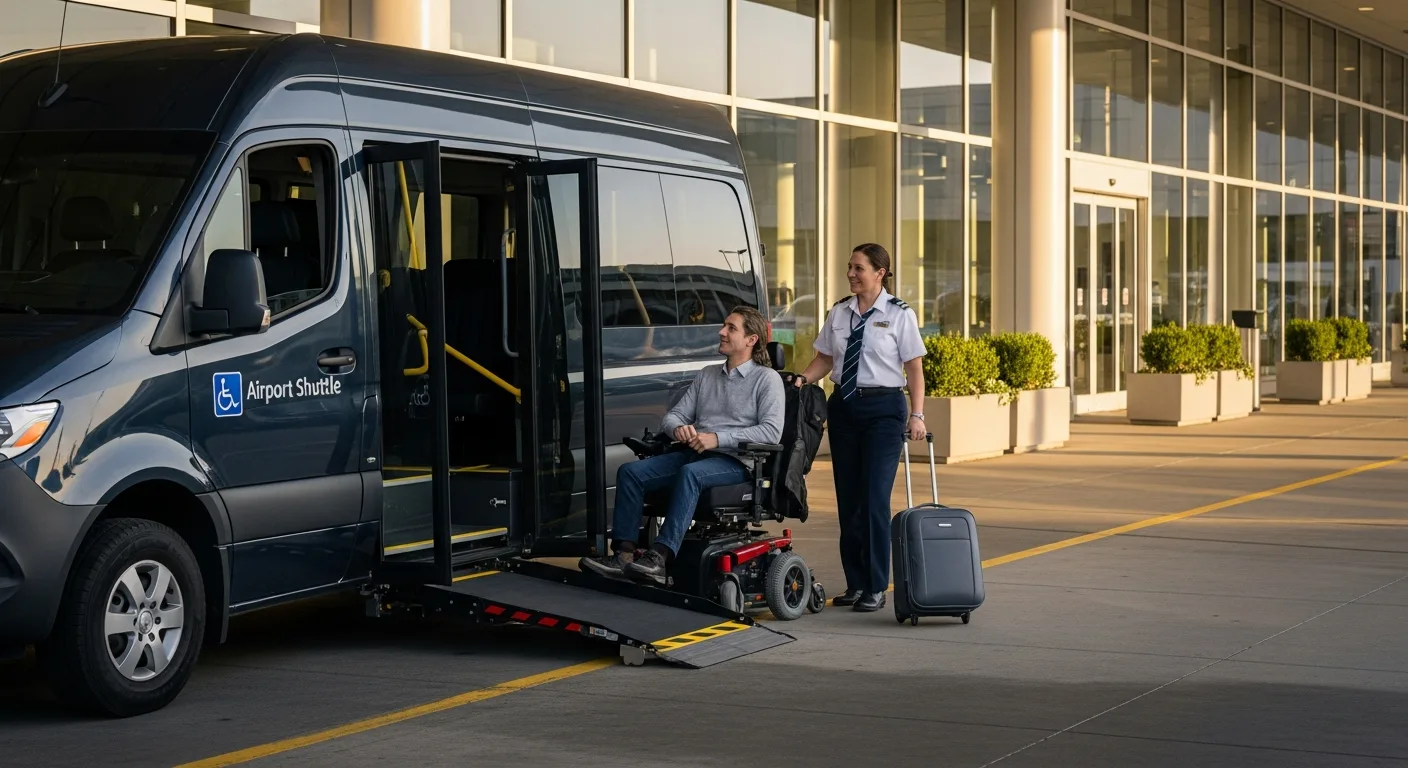
What "Accessible Transfer" Can Mean
The term "accessible" covers a range of requirements. Being specific about what you actually need avoids receiving a vehicle that is partially suitable but operationally insufficient.
A vehicle with a boarding ramp or lift that allows a wheelchair user to remain seated in the wheelchair during travel. The wheelchair is secured inside the vehicle. This requires a specially equipped vehicle — not just any large van.
Mobility scooters are larger than standard wheelchairs and require a ramp or tailgate lift. Specifying the scooter's dimensions and weight at booking allows the correct vehicle to be sourced.
If the passenger can transfer to a standard seat and the wheelchair folds, a large estate car, MPV, or minivan may be sufficient. The folded wheelchair must fit in the boot alongside other luggage.
Some passengers don't use a wheelchair but need physical assistance to board — hip replacements, knee issues, balance problems. A driver briefed on this can assist safely without a modified vehicle.
Airport Coordination for Accessible Passengers
Most major airports offer dedicated assistance services for passengers with reduced mobility — pushchair services through the terminal, priority lanes at immigration, and assistance to the arrivals exit. These services are booked directly with the airline (via the PRM — Persons with Reduced Mobility — assistance request) and do not involve the transfer provider.
However, the handoff between airport assistance and the transfer vehicle matters. If airport staff are assisting you to the arrivals exit, your driver should be at that specific exit — not at a general pickup zone. This connects directly to the importance of precise airport pickup operations coordination, where the driver knows the specific exit point in advance.
Request airport PRM assistance through your airline when booking the flight — not at the airport on the day. The airline notifies the airport, which provisions appropriate support. The transfer and the airline assistance are separate systems that need to be individually booked and cross-coordinated.
What to Specify at Transfer Booking
Do not use "disabled passenger" as the only description. State: "wheelchair user, remains seated in wheelchair during transport" or "foldable wheelchair, can transfer to seat" or "mobility scooter, dimensions X by Y cm, weight Z kg."
Ask explicitly: "Is this booking confirmed with a wheelchair-accessible vehicle?" Do not assume. Standard vehicles cannot accommodate a passenger in a wheelchair.
Airport PRM assistance, transfers between gates and exits, and boarding into the vehicle all take longer for passengers with mobility requirements. Build a larger buffer into your exit time estimate — particularly at large hub airports.
Ask the transfer service to confirm that the driver has been briefed on the accessibility requirement. A driver arriving unprepared for assisted boarding is a coordination failure at the booking stage.
Equipment to Confirm at Booking
- Whether the vehicle has a ramp or lift (not just a large boot)
- The capacity of the ramp or lift (weight limit must accommodate wheelchair + passenger)
- Whether the vehicle has wheelchair tie-downs and restraints
- Space for any additional mobility equipment: crutches, walking frames, portable oxygen
- Whether an assistant or carer traveling with you also needs to be accommodated
Departure Transfers for Accessible Passengers
For departure transfers, additional time at the airport is needed before check-in — PRM check-in assistance must often be requested at a specific desk or service point, and security with mobility equipment takes longer. Build at least 30 to 45 extra minutes into the airport arrival time compared to a standard passenger. The guidance on arrival and departure differences gives the baseline framework; accessible travel adds further time on top.
To explore Transferhood directly, you can visit the main platform.