
How Airport Transfers Work in New York
New York is served by three major airports: John F. Kennedy (JFK) in Queens, LaGuardia (LGA) primarily for domestic flights, and Newark Liberty (EWR) in New Jersey. Each has a different location, terminal structure, and route to Manhattan. Traffic is the dominant variable for all three — what looks like a short distance on a map can take twice as long in practice.
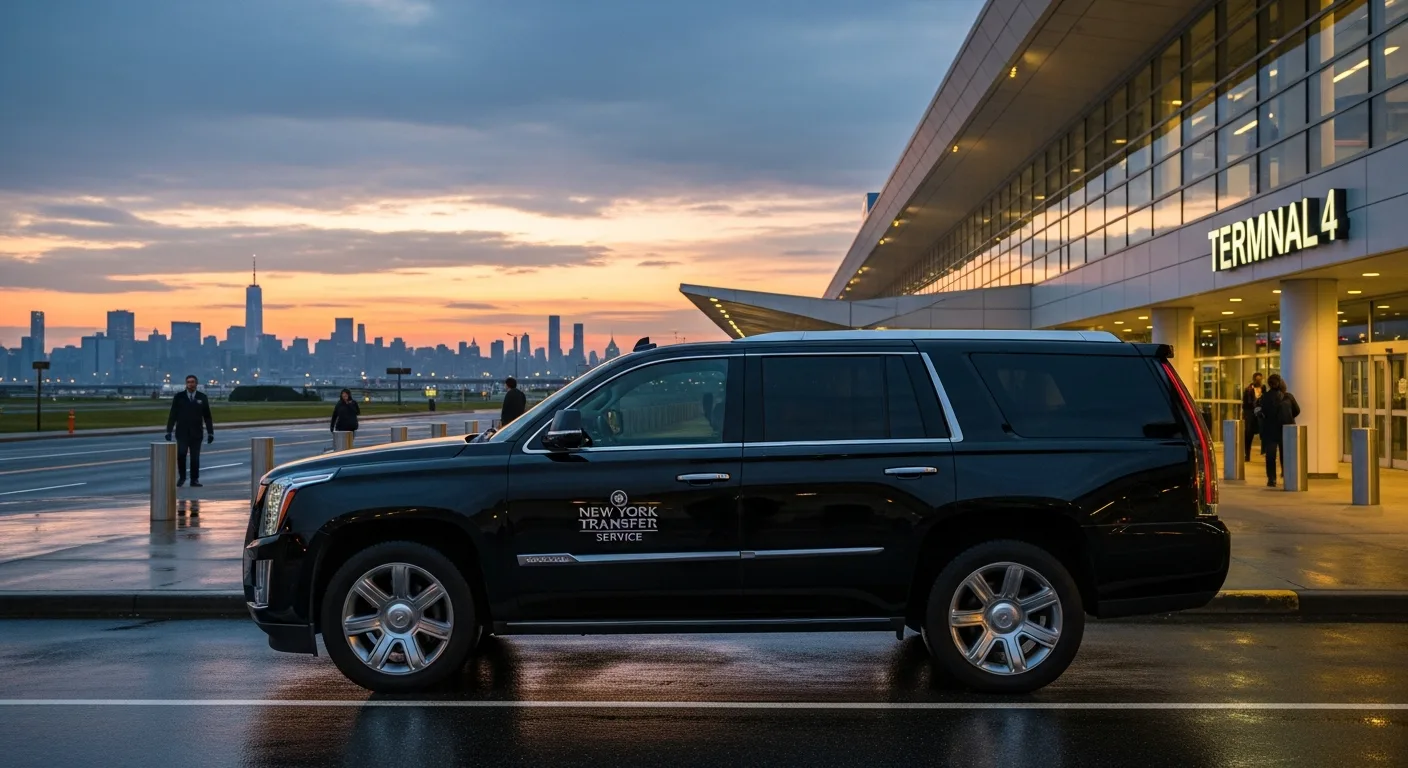
JFK International: Terminal-by-Terminal Complexity
JFK is New York's primary international gateway, located approximately 25 km from Midtown Manhattan. Its defining characteristic for transfers is the terminal layout: JFK has eight terminals arranged in a horseshoe pattern around a central AirTrain loop. Terminal 1, 4, 5, and 8 handle the majority of international traffic. Terminals are not connected by walking — moving between them requires the AirTrain or a road vehicle.
This makes terminal specification absolutely critical at JFK. A driver dispatched to Terminal 4 cannot quickly reposition to Terminal 1 — they are on opposite ends of the airport. Always state the terminal number when providing flight and terminal details for a JFK booking.
- Terminal 1: Air France, Lufthansa, Japan Airlines, Korean Air
- Terminal 4: Delta (international), Emirates, Singapore Airlines, Virgin Atlantic
- Terminal 5: JetBlue
- Terminal 8: American Airlines, British Airways, Iberia, Finnair
LaGuardia (LGA): Domestic Focus, Close to Manhattan
LaGuardia is primarily a domestic airport, handling most major US carriers on intra-US routes. Located 13 km from Midtown Manhattan, it is closer than JFK — but that does not mean faster. LGA access roads feed into the Queensboro Bridge or the BQE (Brooklyn-Queens Expressway), both of which are heavily congested during peak hours.
LGA has two main terminals: Terminal A (Delta mainline, Air Canada) and Terminal B (American Airlines, Southwest, United). The terminals have separate vehicle pickup areas. Newark is on the opposite side of Manhattan and should never be booked in place of LGA.
Newark Liberty (EWR): New Jersey, Different Route Entirely
Newark Liberty is located in New Jersey, approximately 26 km from Midtown Manhattan. It requires crossing either the Lincoln Tunnel, the Holland Tunnel, or the Goethals Bridge — all of which are toll crossings and can be significantly congested. EWR has three terminals (A, B, C) connected by the AirTrain Newark loop.
For passengers whose destination is downtown Manhattan or Brooklyn, EWR can actually be more convenient via the Holland Tunnel than JFK via the BQE. For Midtown-bound travelers, the Lincoln Tunnel option is common. The key variable is tunnel traffic, not just distance.
Drive Times to Midtown Manhattan
25–35 minutes off-peak via the Queens-Midtown Tunnel or Queensboro Bridge. During peak hours (07:30–09:30 and 16:00–19:30), plan for 50–80 minutes. The BQE is the primary bottleneck.
20–30 minutes off-peak via the Queensboro Bridge or Triborough Bridge. During peak hours, 40–60 minutes is realistic. LGA access roads are narrow and congested — limited options for route variation.
25–40 minutes off-peak via the Lincoln Tunnel and NJ Turnpike. During peak hours, 50–80 minutes depending on tunnel conditions. Tunnel backup is the defining variable — no alternative route once in the queue.
20–40 minutes off-peak via the Prospect Expressway or Gowanus. These routes avoid Midtown bottlenecks entirely for passengers staying in lower Manhattan or Brooklyn.
New York traffic is not just "peak hour" in the traditional sense — the BQE, Lincoln Tunnel, and Midtown approaches can be slow at almost any hour during the business day. For JFK and EWR departures, a 90-minute window from most Manhattan hotels is a conservative but practical standard for international check-in times.
What to Confirm When Booking a New York Airport Transfer
For JFK: state the terminal number. For EWR: state A, B, or C. For LGA: state Terminal A or B. Both pieces of information are required for accurate driver positioning.
All three New York airports handle significant international traffic with variable delay patterns. The flight number enables live tracking — critical given how quickly delays can cascade in New York airspace.
New York addresses are precise but dense. Include street number, street name, neighborhood, and borough (Manhattan, Brooklyn, Queens, etc.). This determines route choice and helps avoid routing errors for transfers to outer boroughs.
For departure transfers to JFK or EWR for long-haul flights, set the pickup time to arrive at the airport at least 3 hours before departure. Traffic variability makes 2-hour assumptions risky for international check-in requirements.
Inter-Airport Transfers in New York
Passengers who arrive at one New York airport and need to connect to a flight from another (e.g., JFK arrival, EWR departure) require an inter-airport vehicle transfer. This is an entirely different operation from a city transfer — the route avoids Manhattan entirely where possible, using the Belt Parkway or Van Wyck / NJ Turnpike depending on direction. Allow 60–90 minutes for JFK-to-EWR and 45–75 minutes for JFK-to-LGA inter-airport transfers, with significant buffer for traffic. Understanding how planning international transfers works helps clarify the logistics for multi-airport itineraries.
Book your New York airport transfer through Transferhood — confirmed airport, confirmed terminal, accurate pickup time.