
Why Luggage Details Matter When Booking a Transfer
Luggage information is the most commonly skipped field in airport transfer bookings — and the most reliable predictor of a mismatch at pickup. Trunk capacity is fixed. Arriving with more bags than the vehicle can carry creates a problem that cannot be resolved at the kerb.
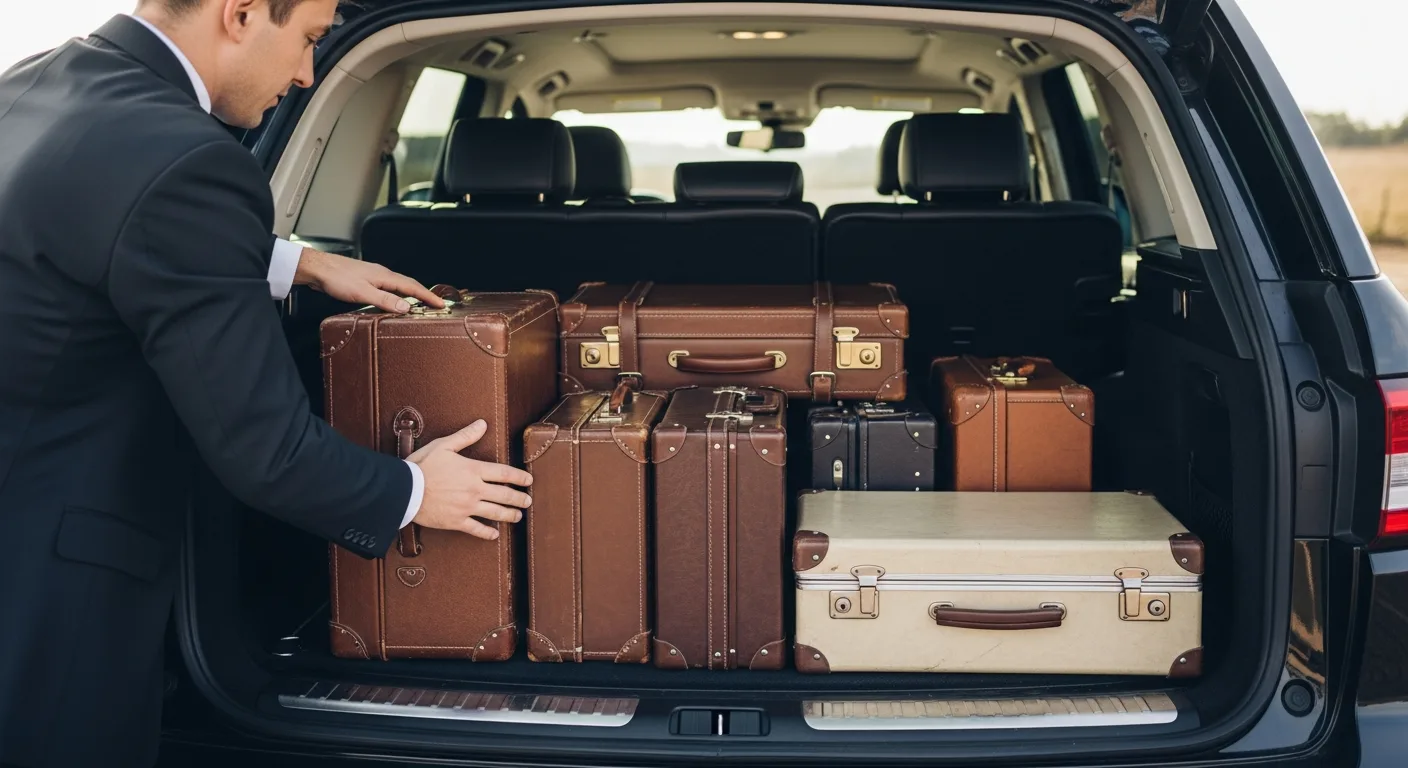
What Happens When Luggage Is Underreported
When a passenger books a vehicle without accurately specifying their luggage, the system assigns a vehicle based on incomplete information. On the day of travel, if the actual luggage volume exceeds the assigned vehicle's boot capacity, there are limited options: bags travel in the cabin (if there is room), a second vehicle is requested at short notice, or the booking needs to be modified urgently. None of these are efficient outcomes.
Understanding how passenger count and vehicle fit interact helps, but luggage volume is the factor most often left unaddressed at the booking stage.
Trunk Capacity Varies Significantly by Vehicle Category
Boot volume typically ranges from 400-480 litres depending on model. This fits approximately 2-3 standard 23kg suitcases. There is limited flexibility for oversized items.
Marginally more space in most models — similar to Economy in practical terms. Two large bags and two cabin bags is close to the practical limit for most configurations.
Boot volume typically 500-700 litres or more depending on model configuration. This handles 4-5 standard suitcases comfortably and accommodates some oversized items.
The highest combined passenger and luggage capacity across all categories. Strollers, large sports bags, and full luggage sets for 4-6 passengers are typically within range.
Oversized Items Require Specific Planning
Standard luggage inputs — number of bags and approximate size — cover most trips. But certain item types require specific attention because they occupy disproportionate boot space relative to their weight or apparent size.
A standard ski bag (160-180cm) typically fills the majority of a sedan's boot on its own. Even an SUV boot may require loading at an angle. Booking an SUV or Minivan is almost always necessary when ski equipment is part of the trip.
Foldable strollers occupy 40-60 litres when folded — equivalent to a medium suitcase. Non-foldable or large pushchairs require significantly more space. This must be declared at booking alongside standard luggage.
Golf bags, bicycle cases, surfboard bags, and similar items are not accommodated in standard sedan vehicles. An SUV or Minivan is necessary, and in some cases advance notification to the operator is required.
Large instrument cases (cellos, bass guitars in hard cases, keyboard cases) are considered oversized. Their dimensions may prevent standard sedan loading even if boot volume is theoretically sufficient.
The Difference Between Bags and Pieces
A "bag" in transfer booking context means a piece of luggage that occupies defined boot space — not a personal item or a soft tote that can be placed underfoot in the cabin. When counting luggage for booking purposes:
- Large checked suitcases (23-32kg airline limit): count each one as a standard piece
- Medium suitcases (15-20kg range): count each one
- Carry-on bags (cabin luggage size): count these as additional pieces if they will go in the boot
- Laptop bags, handbags, small backpacks: these typically travel in the cabin and do not count against boot capacity
When passengers say "just two bags," they often mean two large checked suitcases plus carry-ons plus personal items. The total boot-occupying pieces can be four or five. Count each piece that will go into the trunk, not each passenger's overall luggage load.
How Luggage Details Drive Vehicle Category Selection
Accurate luggage input is what enables the correct vehicle category selection. The system uses this information to verify that the selected vehicle can handle the trip. When the input is skipped or underestimated, the system assigns based on passenger count — which, as described above, is an incomplete picture. The practical consequence is a vehicle that arrives at the correct time but cannot fit the actual luggage.
What to Specify When Booking
- Number of large checked bags (23kg airline standard size)
- Number of cabin bags (carry-on size)
- Any oversized items: type and approximate dimensions if possible
- Child equipment: strollers, child seats, buggy boards
- Sports or specialist equipment: ski bags, golf bags, bike cases
This is also covered in the context of common vehicle selection mistakes — where underreporting luggage features as one of the most frequent causes of booking problems.
To explore Transferhood directly, you can visit the main platform.