How Ferry Timing Differs From volo Timing
Ferries depart on fixed timetables with strict boarding cutoffs — typically 30 to 60 minutes before partenza for veicolo-carrying ferries, and 15 to 30 minutes for passeggero-only services. These cutoffs are enforced, unlike airlines that occasionally hold for connecting passeggeros or late check-in bags.
Unlike a volo where you receive real-time delay information, ferry schedules are generally either on time or delayed due to weather or technical issues. You won't have the equivalent of monitoraggio dei ritardi del volo for ferry services — the transfer timing buffer needs to be built more conservatively as a result.
For ferry transfers, the recommended orario di arrivo at the terminal is the operator's stated check-in deadline plus at least 20 minutes of buffer. Ferries in high-season Mediterranean or Aegean routes can have significant porto congestion — a 45-minute buffer from terminal arrival to boarding cutoff is not excessive for peak-season routes.
Embarkation vs Arrival at terminal dei traghettis
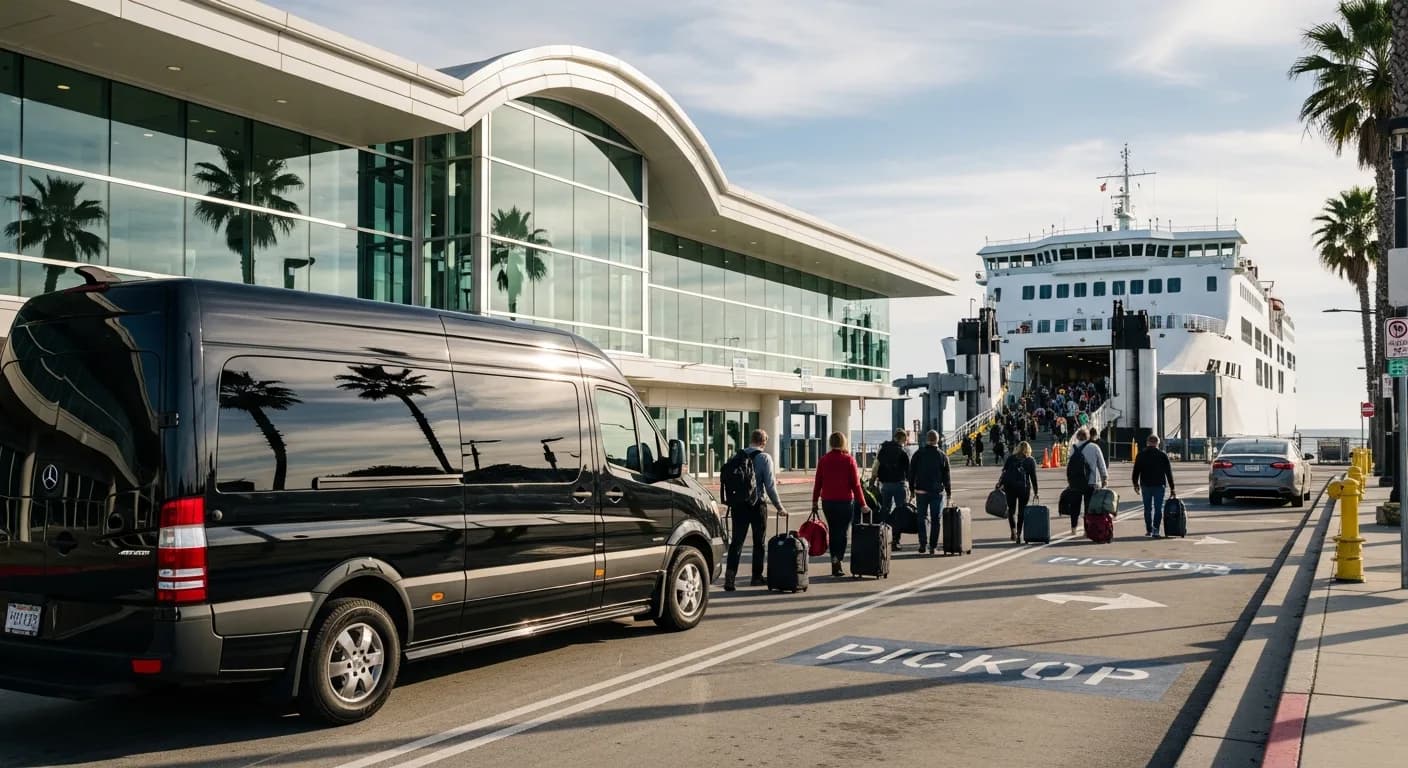
Timing is driven by the ferry's partenza and check-in deadline. veicolo check-in (for car-carrying ferries) opens 90 to 120 minutes before partenza — veicolo passeggeros need to be in the loading queue earlier than foot passeggeros. Plan the transfer to arrive before the veicolo check-in queue becomes long.
Ferry arrivi can be on time or delayed by up to 1 to 2 hours in bad weather. For prelievo transfers from a terminal dei traghetti, building a flexible wait window into the prenotazione is importoant. Confirm with the transfer provider that the autista will monitor orario di arrivo rather than a fixed clock prelievo.
Multiple Embarkation Points at Large portos
Large ferry portos (e.g., Piraeus, Bari, Brindisi, Calais, Dover, Ancona) have multiple quays handling different ferry operators. A autista arriving at the wrong quay faces a significant walk or veicolo repositioning. Specify your ferry operator and route — not just the porto city — when prenotazione a transfer to a terminal dei traghetti.
Planning a terminal dei traghetti Transfer
Provide your ferry operator name, route, and orario di partenza. This allows the transfer service to identify the correct quay or gate within the porto complex.
Ferry passeggeros often carry full holiday bagagli — larger loads than a typical airporto trip. Declare the total number and size of bags at prenotazione. An undersized veicolo at the porto cannot be replaced quickly.
veicolo passeggeros must queue in the embarkation lanes, which fill up 60 to 90 minutes before partenza on busy routes. A transfer dropping foot passeggeros only needs less lead time than one for a veicolo-carrying route.
Ferry orario di arrivos are less predictable than airline arrivi. Book a flexible Transfer di Ritorno — not a fixed-time prelievo — or confirm that the autista will monitor the ferry's actual orario di arrivo before committing to a precise meet time.
How Ferry Transfers Differ From transfer aeroportouales
- Timing tied to ferry schedule, not a monitored volo — conservatively buffered
- Multiple quays within the same porto — operator-specific staging required
- bagagli loads typically heavier — categoria di veicolo must account for this
- For veicolo ferries: loading queue time adds pre-boarding requirement
- Transfer di Ritornos from ferries need flexible timing to accommodate weather delays
The underlying logic of structured planning for porto-based transfers mirrors the reasoning in why structured planning matters for transfer aeroportouales — the environment is different but the need for accurate information at prenotazione is the same.
To explore Transferhood directly, you can visit the main platform.