Terminal 1 and Terminal 2
Frankfurt Airport (FRA) has two passenger terminals. Terminal 1 handles the majority of traffic, including all Lufthansa operations and Star Alliance carriers, as well as many other international airlines. Terminal 2 is the newer facility, handling a selection of international carriers and Condor, among others. The two terminals are connected by the SkyLine Skytrain, a fully automated people mover that runs between them in a few minutes — but for ground vehicle pickup purposes, they are accessed via different road approaches and vehicle waiting areas.
T1 is internally divided into concourses: A and B for non-Schengen international arrivals; C for Schengen and domestic; Z for Lufthansa First Class. The concourse your gate is in affects how long it takes to exit the terminal — some require long internal walks and escalator sequences. Arrivals exit at Level 1 into the central arrivals hall.
More compact than T1. Non-Schengen international arrivals exit on the ground level into a single arrivals area. Private transfer vehicles collect from the P36 parking facility adjacent to T2. The T2 exit-to-vehicle connection is generally faster than T1 due to the smaller footprint.
At Frankfurt, terminal specification matters — but so does concourse. Lufthansa long-haul arrivals at Concourse A or B require clearing passport control and baggage reclaim before exiting. The total time from landing to terminal exit can range from 30 to 60 minutes on busy intercontinental flights. Plan your driver positioning around estimated exit time, not landing time.
Transfer Vehicle Pickup at FRA
Private transfer vehicles at Terminal 1 collect from the parking areas adjacent to the arrivals level exit. The most common arrangement for professional transfers is the P2 or P3 short-stay structures at T1, with the driver meeting passengers in the arrivals hall using a name board. For T2, the P36 parking and exterior curbside area is typically used. Drivers are not permitted to idle at the curbside indefinitely — a professional transfer service accounts for this in how they coordinate pickup timing.
This is part of how professional airport pickup operations work at a large hub — pre-confirmed meeting points, flight monitoring, and coordinated exit timing reduce the uncertainty of finding your vehicle.
Key Destinations and Timing
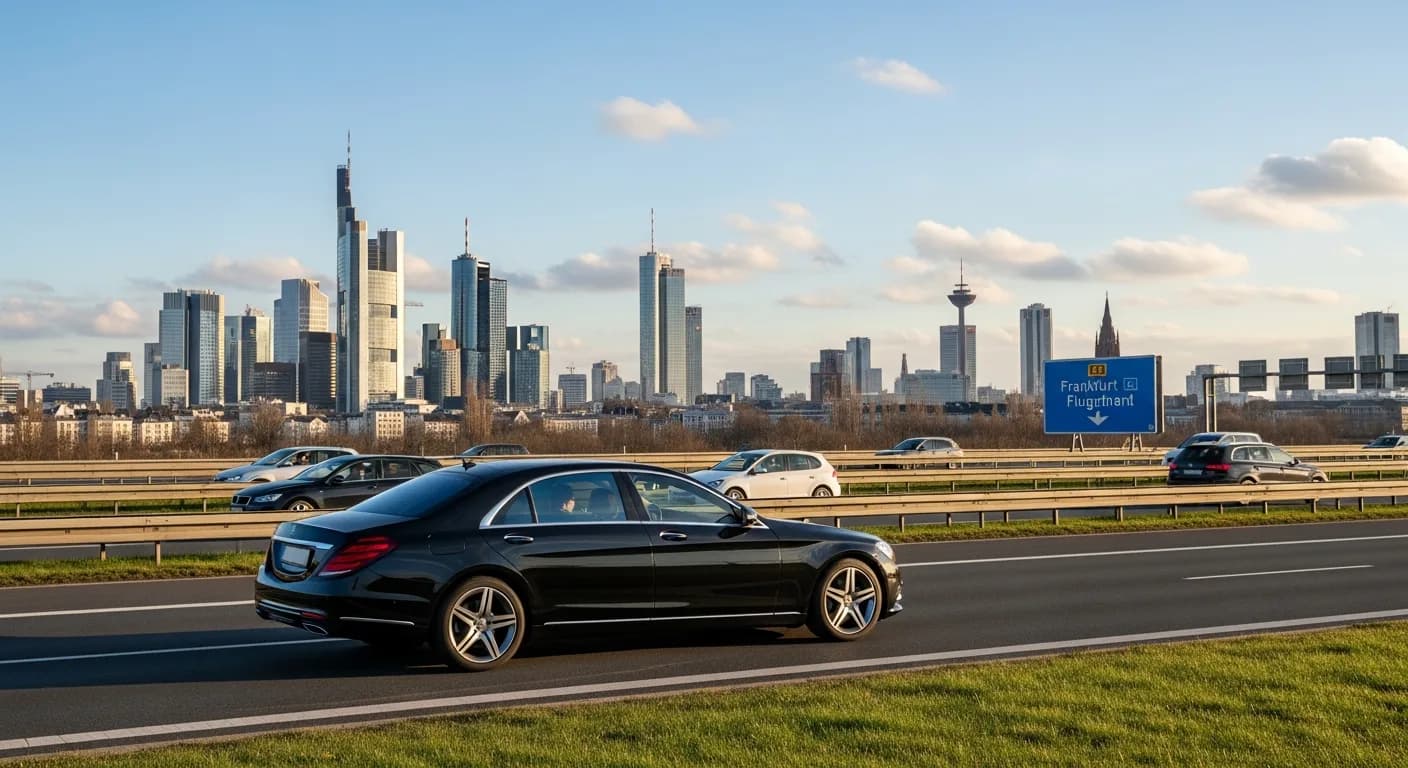
Frankfurt Airport sits at the A3/A5 motorway junction, southwest of the city. The A3 leads east toward Frankfurt city center and the Autobahn network beyond. The A5 runs north-south toward Heidelberg, Darmstadt, and further south toward Munich. The airport's position makes it an effective gateway for a wide region, not just Frankfurt city.
- FRA to Frankfurt city center (Innenstadt, Sachsenhausen, banking district): Plan for 20–35 minutes. The A3 eastbound approach is direct, but the Frankfurt city exit can be congested during morning and evening peaks.
- FRA to Messe Frankfurt (trade fair grounds): Plan for 20–30 minutes. During major trade fairs (IAA, Frankfurt Book Fair, Automechanika), the approach roads around the Messe are significantly heavier — add 15–30 minutes.
- FRA to Frankfurt Europaviertel / Westend (hotel and business district): 20–35 minutes via the A66.
- FRA to Heidelberg: Plan for 50–70 minutes via the A5 south. One of the most common inter-city routes from FRA.
- FRA to Darmstadt: Plan for 30–45 minutes via the A67 south.
- FRA to Wiesbaden / Mainz: Plan for 25–40 minutes westbound via the A3/A66.
- FRA to Mannheim: Plan for 55–75 minutes via the A5 south.
The A3/A5 Junction: Frankfurt's Congestion Hub
The interchange where the A3 (east-west) and A5 (north-south) motorways meet near the airport is known colloquially as the "Frankfurter Kreuz" and is one of the busiest motorway intersections in Europe. Congestion here, particularly during weekday morning inbound hours (07:00–09:30) and evening outbound hours (16:30–19:00), can add 15–30 minutes to any route that uses this junction. For transfers between the airport and Frankfurt city, this affects the most direct corridor. Monitor conditions when selecting your pickup time and allow a realistic buffer.
What to Specify When Booking
These have separate road access and vehicle collection areas. Confirming your airline at booking allows the provider to verify the correct terminal assignment, as carrier-terminal mapping can occasionally change.
FRA serves Frankfurt city as well as a wide surrounding region. "Frankfurt" is not sufficient if your destination is Heidelberg, Darmstadt, or another city. Provide the full address so the correct route and vehicle are planned. Review the general approach to airport to hotel transfers for longer inter-city runs.
Frankfurt handles many long-haul intercontinental arrivals with variable exit times. Flight number enables the driver to track the actual landing and adjust positioning accordingly. This is covered in how flight and terminal details support the pickup operation.
If your visit coincides with a major Frankfurt trade fair, state this. It affects both routing choices and the required traffic buffer. Routes via the Messe area may need to be avoided or extra time built in.
To explore Transferhood directly, you can visit the main platform.