
How Multiple-Terminal Airports Complicate Transfer Coordination
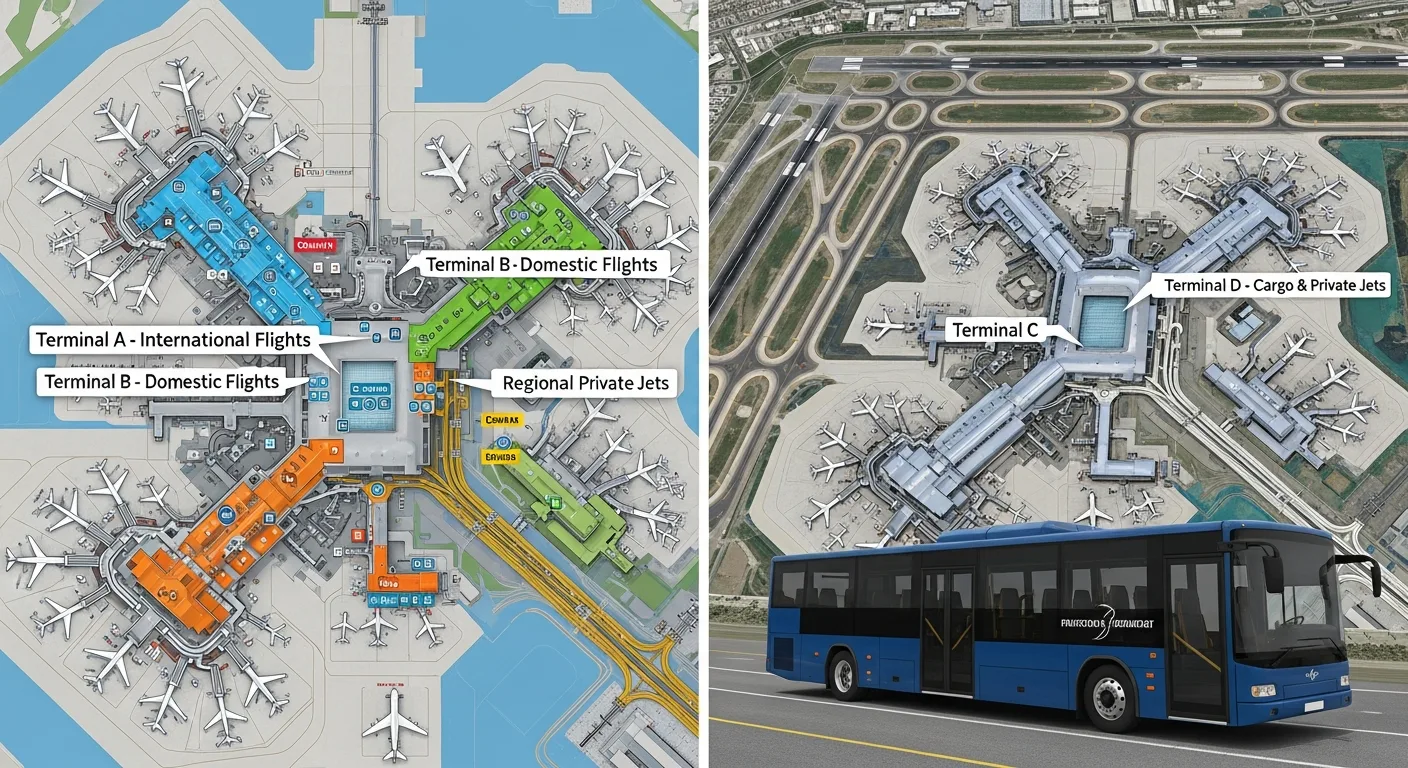
At a multi-terminal airport, terminals are separate buildings accessed by different roads, with their own arrivals halls and vehicle pickup zones. A driver at the wrong terminal cannot simply walk across — they must reposition by vehicle. This is why terminal specification is the single most critical detail at these airports.
Why Terminals Aren't Interchangeable
At airports like London Heathrow, Dubai DXB, Paris CDG, or Frankfurt FRA, each terminal is a standalone building with its own road system. A driver cannot approach Terminal 5 and then walk to Terminal 2 — those buildings are separated by kilometres of airport infrastructure, and foot access between them does not exist on the landside.
When a driver is positioned at the wrong terminal, the options are: wait while the passenger navigates to find the driver (usually confusing and slow), or have the driver reposition by vehicle (10 to 25 minutes depending on the airport). Both outcomes create delay. Neither is acceptable for a well-coordinated transfer.
How Drivers Are Positioned Per Terminal
Professional transfer services position drivers at a specific terminal based on the booking information received. The driver enters the airport approach road for that terminal, parks in the designated private hire zone, and proceeds to the arrivals hall. This process is terminal-specific from the start — there is no "airport-level" positioning that can then adapt to any terminal.
This is why the booking process asks for your airline and flight number in addition to the terminal. Flight number allows the terminal to be cross-verified. If a passenger accidentally selects the wrong terminal, a good booking system catches the discrepancy before the driver is dispatched.
What Happens When the Wrong Terminal Is Given
The transfer service catches the terminal mismatch when cross-referencing the flight number. Correction is made before the driver is sent. No impact on the transfer.
Driver is already positioned at the wrong terminal. Passenger exits and cannot find the driver. Both parties call each other. Driver repositions — 15 to 25 minutes lost, depending on airport.
Less common but possible — passenger misremembers terminal from booking email and heads to wrong building. They must take an inter-terminal shuttle or bus back to correct terminal.
Airline switches operating terminal after booking — not uncommon with temporary reassignments. A monitoring service that tracks flight and terminal details in real time can catch this and update the driver.
Inter-Terminal Transfer Logistics
When a passenger needs to move between terminals — for example, they arrive at T1 and need to exit from T3 (which doesn't happen operationally, but analogously when a group splits across flights at different terminals) — airport inter-terminal shuttles and buses exist. However, they are not fast, are not designed for passengers with heavy luggage, and require navigating a new terminal on arrival.
For transfer passengers, the practical rule is simple: your driver meets you at the terminal where your flight arrives. Specifying this correctly at booking removes the inter-terminal problem entirely.
What to Confirm Before Booking at Multi-Terminal Airports
Most airlines print the terminal on the boarding pass. Check this rather than guessing from the airline's general terminal assignment, which can change.
Flight number allows the terminal to be verified independently. At airports with sub-terminals (like CDG T2A through T2G), the flight number is the only reliable way to determine the correct sub-terminal.
Airlines occasionally move flights between terminals with limited notice. Check your booking confirmation 24 hours before travel. If your terminal has changed, update your transfer booking.
Services with flight delay monitoring track not only delays but also terminal changes in real time, updating driver positioning automatically.
Airport-Specific Terminal Complexity
Not all multi-terminal airports are equally complex. Some have two terminals clearly separated by a 10-minute drive. Others — like CDG — have seven sub-terminals within Terminal 2 alone, each with a separate access road. The coordination requirements scale with complexity. Planning around why structured planning matters becomes increasingly important as airport complexity increases.
The Traveler's Checklist for Multi-Terminal Airports
- Confirm your terminal from your airline confirmation or boarding pass — not from memory
- For CDG: confirm the full sub-terminal code (2A, 2E, etc.) not just "Terminal 2"
- For DXB: confirm T1, T2, or T3 — Emirates uses T3 exclusively
- For LHR: confirm T2, T3, T4, or T5 — T5 is British Airways only and far from others
- For FRA: confirm T1 or T2 and, if T1, which hall (A, B, or C) for best driver positioning
To explore Transferhood directly, you can visit the main platform.