
How Airport Transfers Work in Madrid
Madrid Barajas has four terminals grouped into two separate areas. T4 is the Iberia hub and sits roughly 10 km from T1–T3. This internal distance means terminal specification determines not just where the driver positions — it affects the entire pickup sequence.
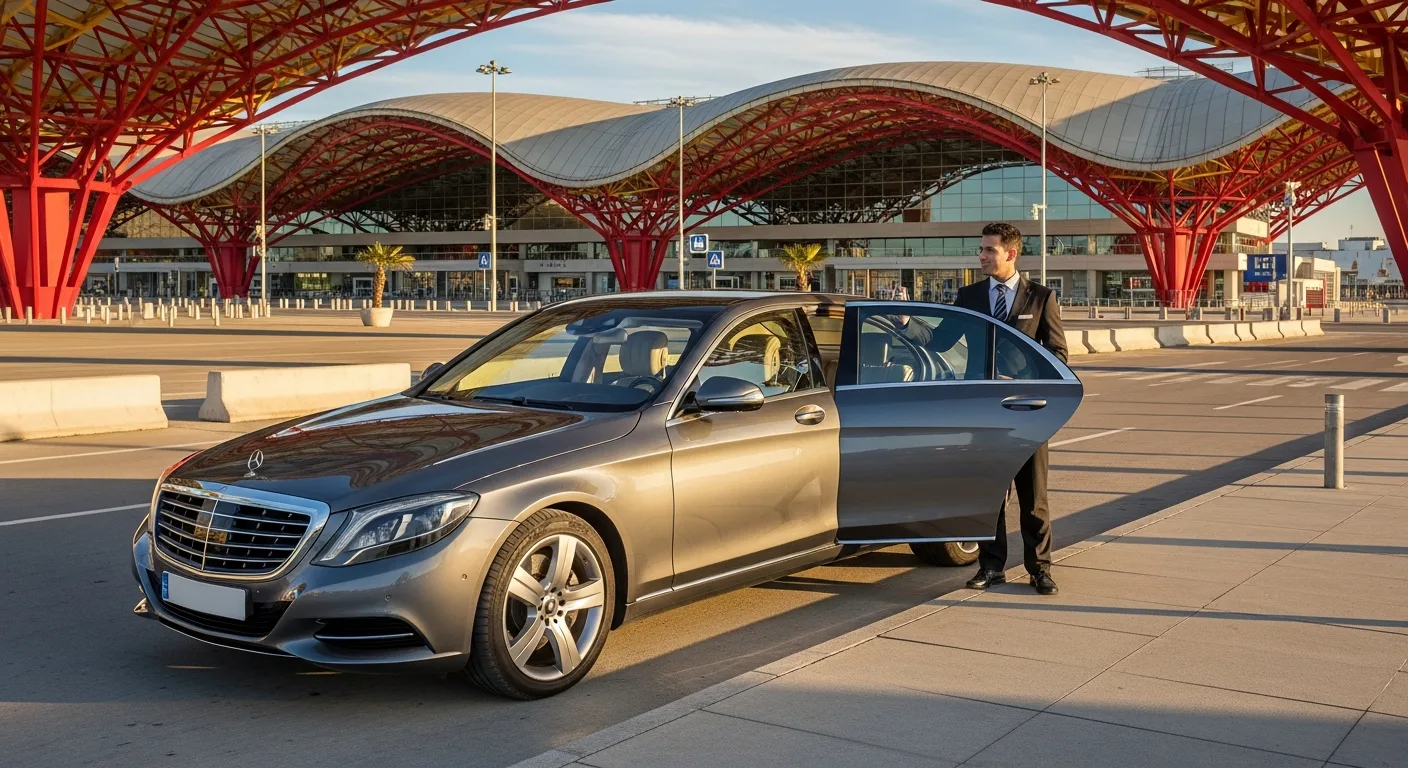
Barajas Terminal Layout: Two Separate Groups
Adolfo Suárez Madrid-Barajas Airport (MAD) is organized into four terminals across two geographic clusters. Terminals 1, 2, and 3 are grouped together in the original section of the airport and are connected by internal walkways. Terminal 4 and its satellite T4S are a separate building complex approximately 10 km away from the T1–T3 cluster by road, connected to T1–T3 via a free shuttle bus — not by any walking or direct indoor connection.
The original terminal group, handling a range of international carriers — primarily non-Iberia group flights. T1 is the main non-Schengen international arrivals building for carriers outside the Iberia alliance. T2 handles primarily Schengen arrivals and some European routes. T3 is the smallest and handles domestic connections. Private transfer vehicles collect from the designated zones outside arrivals at T1 and T2.
The Iberia hub and primary Oneworld carrier terminal. T4 is a large, modern facility designed by Richard Rogers. T4S (the satellite building) handles additional capacity for international long-haul flights. T4 and T4S are connected internally by a dedicated underground people mover. From T4 arrivals, private transfers collect from the Zona de Espera (waiting area) on Level 0 outside the arrivals exit.
A driver positioned at T4 cannot reach T1–T3 in time if the wrong terminal is specified. The 10 km road distance between the two terminal groups means an error here costs a significant amount of time. Always confirm your terminal from your airline ticket or app before booking.
Routes to Madrid City Center
The airport is northeast of Madrid city center. The primary road connection is the M-11 motorway, which connects directly to the M-40 ring road and from there to the radial roads into central Madrid. The R-2 toll road is an alternative for certain routes.
- T4 to Madrid city center (Sol, Gran Vía, Recoletos): Plan for 25–45 minutes via the M-11 and M-40. T4 has good motorway access from its position. During morning peak (08:00–10:00), plan for up to 55 minutes.
- T1–T3 to Madrid city center: Similar routing but from the opposite end of the airport complex. Plan for 25–40 minutes off-peak, up to 55 minutes in morning peak conditions.
- Airport to Atocha Station area (south Madrid hotel district): Plan for 30–50 minutes. The route from either terminal group involves the M-30 inner ring or M-40 — both can be congested during peak hours.
- Airport to IFEMA (trade fair and convention center): IFEMA is adjacent to T4, making this one of the shortest transfer routes at Barajas — plan for 5–15 minutes from T4, 15–25 minutes from T1–T3.
- Airport to Castellana (business and hotel corridor): Plan for 30–45 minutes. The Paseo de la Castellana runs north-south through central Madrid and is a common destination for corporate travelers.
The M-40: Madrid's Ring Road Variable
The M-40 orbital motorway is the main connective ring for transfers between Barajas and Madrid's various districts. It handles high traffic volumes on weekday mornings and evenings, with the northeastern sections (Barajas approach) and the southern arc (toward Atocha and southern Madrid) being the most congested. A realistic buffer of 15–20 minutes should be applied during any weekday peak period when selecting your pickup time.
What to Specify When Booking
This is the single most important specification for Madrid transfers. Confirm which terminal cluster applies to your flight before placing your booking.
Madrid's hotel and business districts span the city along the Castellana corridor and the inner city. A full street address ensures the correct routing via the M-40 and the appropriate inner-city approach.
Enables driver positioning adjustment and real-time monitoring of your actual arrival. Particularly useful for connections through Madrid on Iberia at T4. How flight and terminal details support the operation is explained in the linked guide.
Madrid's IFEMA convention center hosts major international events that generate large vehicle volumes around T4. If your visit coincides with a trade show, communicate this — it affects both approach routes and the timing buffer needed for your transfer.
For a full overview of how the arrival and departure phases of a transfer are coordinated differently, see the guide on arrival and departure transfer operations.
To explore Transferhood directly, you can visit the main platform.