Embarkation vs Disembarkation: Two Different Transfers
Cruise port transfers split into two distinct types — the transfer to the port at the start of the cruise (embarkation) and the transfer from the port at the end (disembarkation). The logistics differ significantly between them.
- Timing tied to ship's boarding window (often 12:00–16:00)
- Passengers typically arrive from hotel or airport with full baggage
- Port check-in queues during peak boarding hours
- Vehicle approaches port entrance / terminal gate
- No "flight monitoring" equivalent — timing is fixed by ship schedule
- Timing tied to ship's disembarkation schedule (often 07:00–11:00)
- Passengers exit with full luggage after customs/port processing
- Multiple groups exiting in waves by deck or luggage tag color
- Transfer to airport, hotel, or city — timing may be flight-critical
- Exit time variable by allocated disembarkation group
Luggage Volume: The Critical Difference
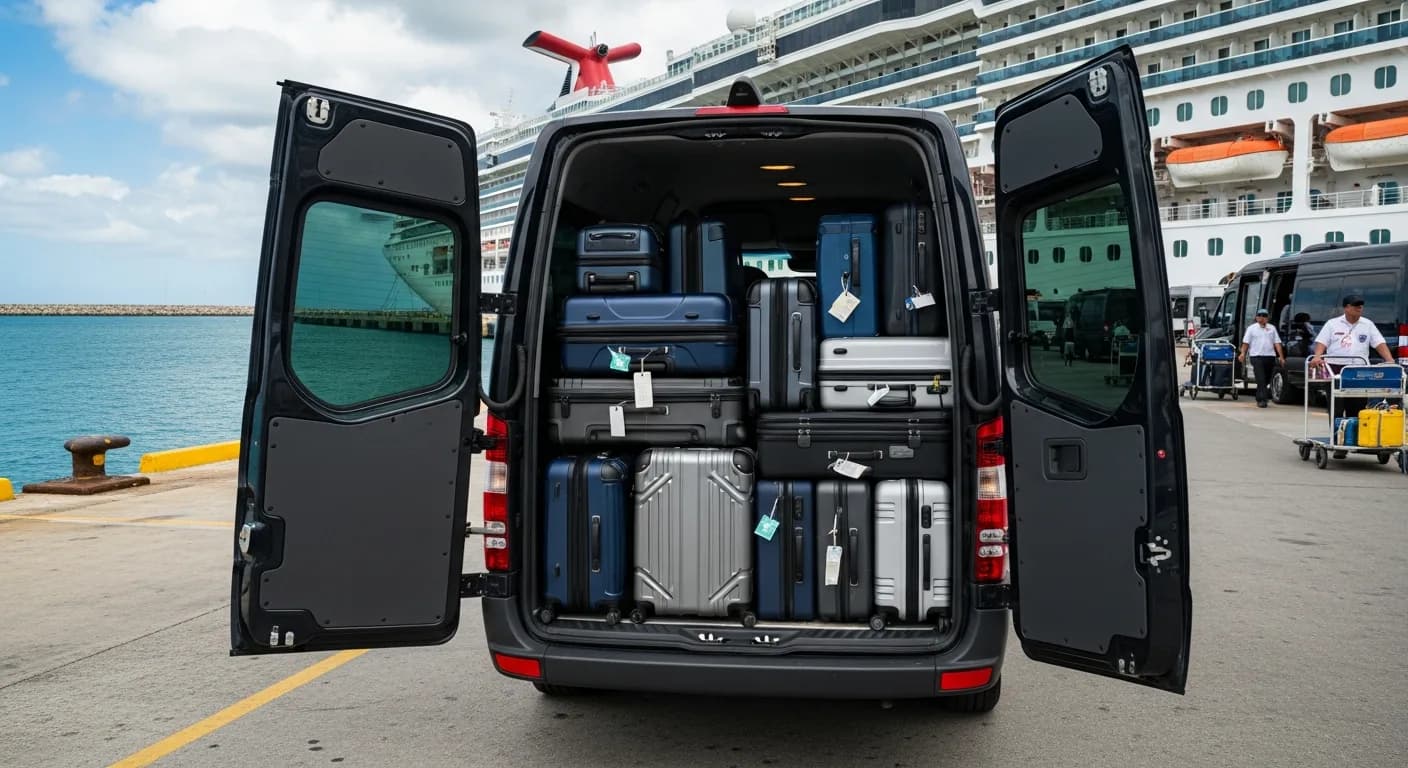
Cruise passengers carry more luggage than most air travelers. A 7-night cruise commonly generates 2 to 4 large suitcases per couple, plus carry-on bags, duty-free purchases, and potentially sports or water equipment. This has a direct impact on vehicle selection.
A standard sedan cannot accommodate a family of four's cruise luggage. An MPV or minivan is typically required. Declare your luggage count accurately at the booking process stage — luggage mismatches at a port are harder to solve than at an airport. The guidance on appropriate vehicle category selection is directly applicable here.
Port Access and Pickup Logistics
Large ports (e.g., Barcelona, Southampton, Piraeus, Istanbul) have multiple berths. Different ships dock at different terminals within the same port complex. Specify your cruise line and ship name, not just the port city.
Most cruise ports restrict vehicle access to authorized drop-off and pickup zones. Private transfer vehicles do not park at the gangway — they use designated port vehicle zones, similar to airport pickup structure.
Arriving at the port does not mean boarding immediately. Check-in, security screening, and gangway queues can add 30 to 60 minutes. Arrive during the quieter middle window of the boarding period, not at peak opening time.
If you have a flight after disembarking, your disembarkation group timing is critical. Request the earliest possible disembarkation group if your flight is before 13:00. Share your flight time with your transfer provider.
For disembarkation transfers connecting to a flight, the same principles as departure transfer planning apply — but with added port processing time. If your ship is at berth by 06:30 and you have a 12:00 flight, you need to calculate disembarkation processing, port exit, transfer journey time, and airport check-in all in sequence.
What to Specify When Booking a Port Transfer
- Whether the transfer is to the port (embarkation) or from the port (disembarkation)
- Port name and city
- Cruise line and ship name — determines the specific berth or terminal
- Total number of passengers and bags (including large cruise luggage)
- For disembarkation: your allocated disembarkation time or group
- For disembarkation with a flight: your flight number and departure time
To explore Transferhood directly, you can visit the main platform.